The Evolution of International Wheel Safety Standards: From Compliance to Ultimate Reliability
The wheel is more than just a circular component that gets your vehicle moving. It’s the only part that consistently connects your car to the road, making its safety standards a fundamental cornerstone of automotive engineering. International wheel safety regulations are far from static; they’re constantly evolving, pushed forward by advancements in material science, increasingly complex vehicle performance, and a deeper understanding of real-world driving demands.
This journey has transformed expectations from mere compliance to the pursuit of ultimate, unwavering reliability. At AegisRim, we don’t just meet these evolving standards—we help define what the future of wheel safety should look like across North American markets and beyond.
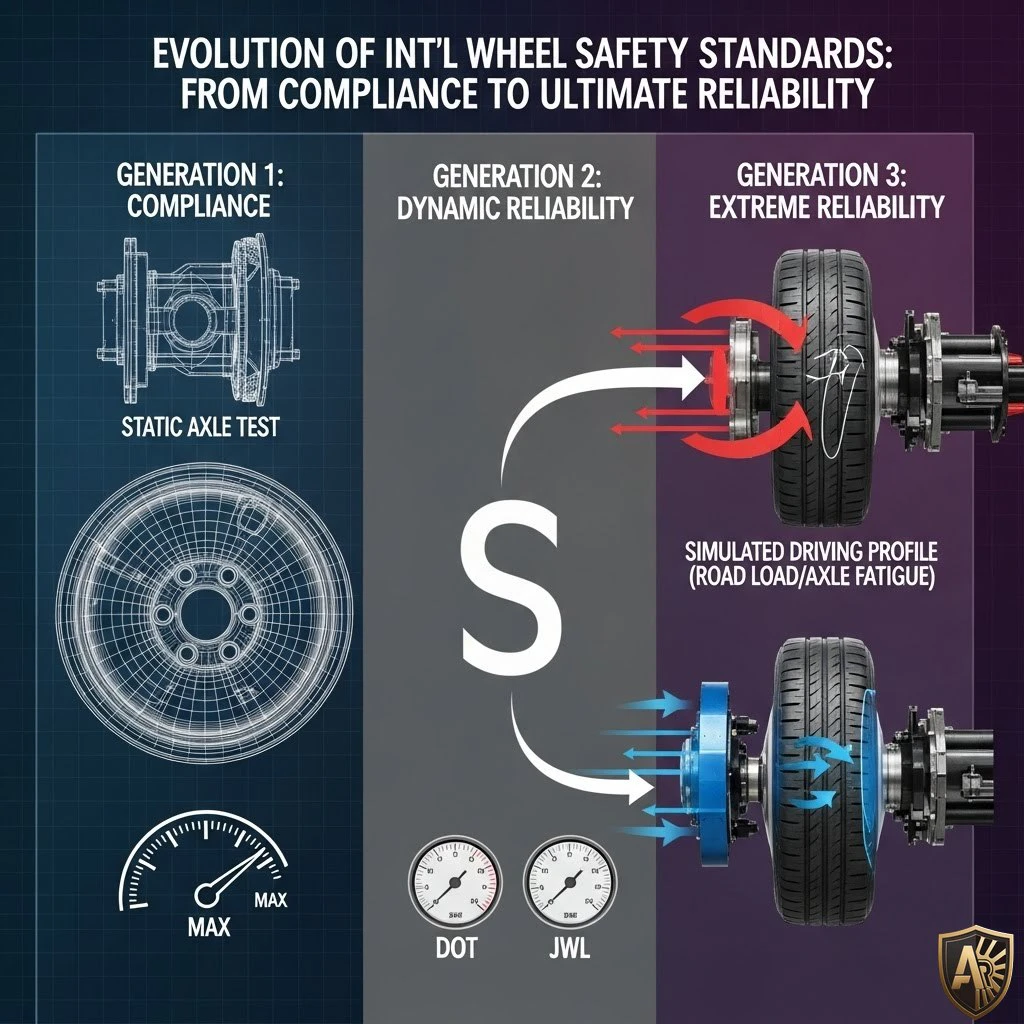
The Generational Shift in Regulations
Understanding modern wheel safety means looking back at how these standards have evolved. We’ve seen a clear progression through different “generations” of regulatory focus, each building upon the last to enhance vehicle and passenger safety. This evolution reflects not just technological advancement, but also hard-learned lessons from real-world accidents and failures.
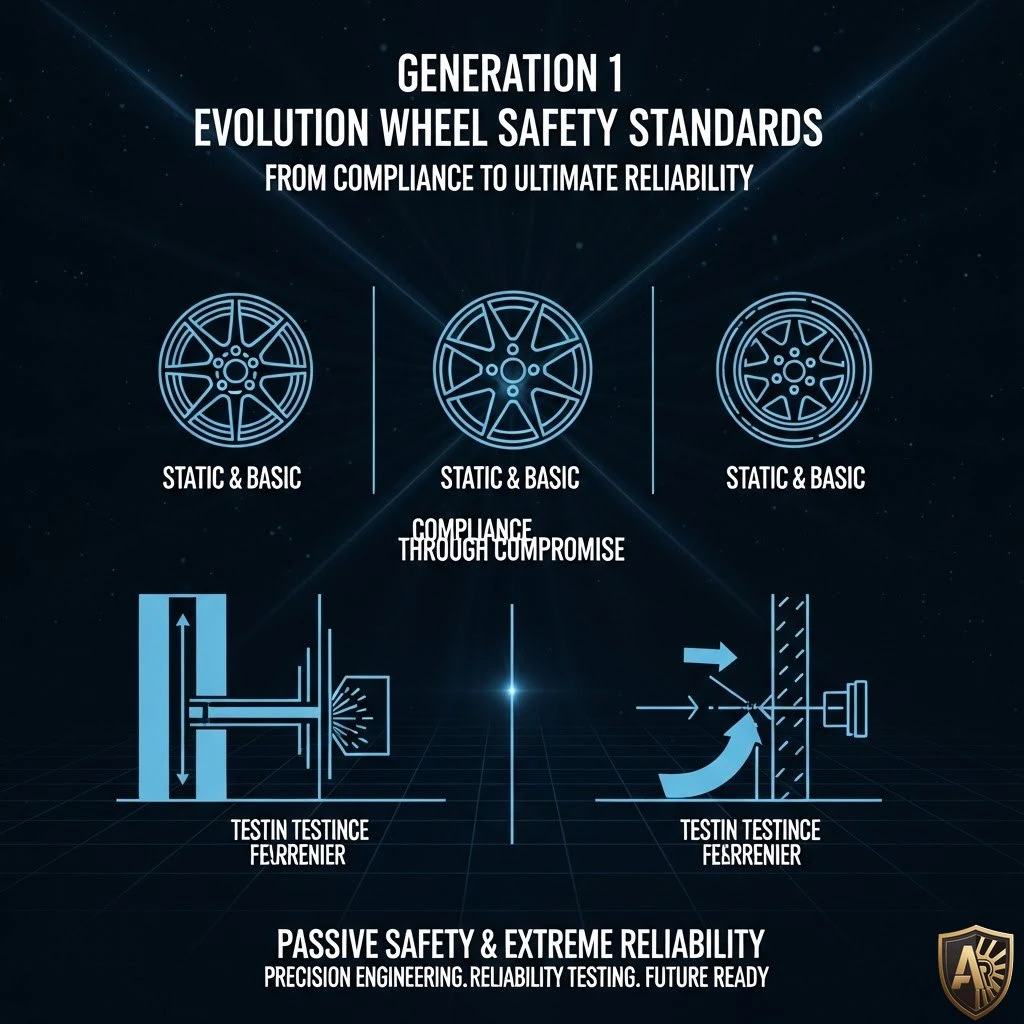
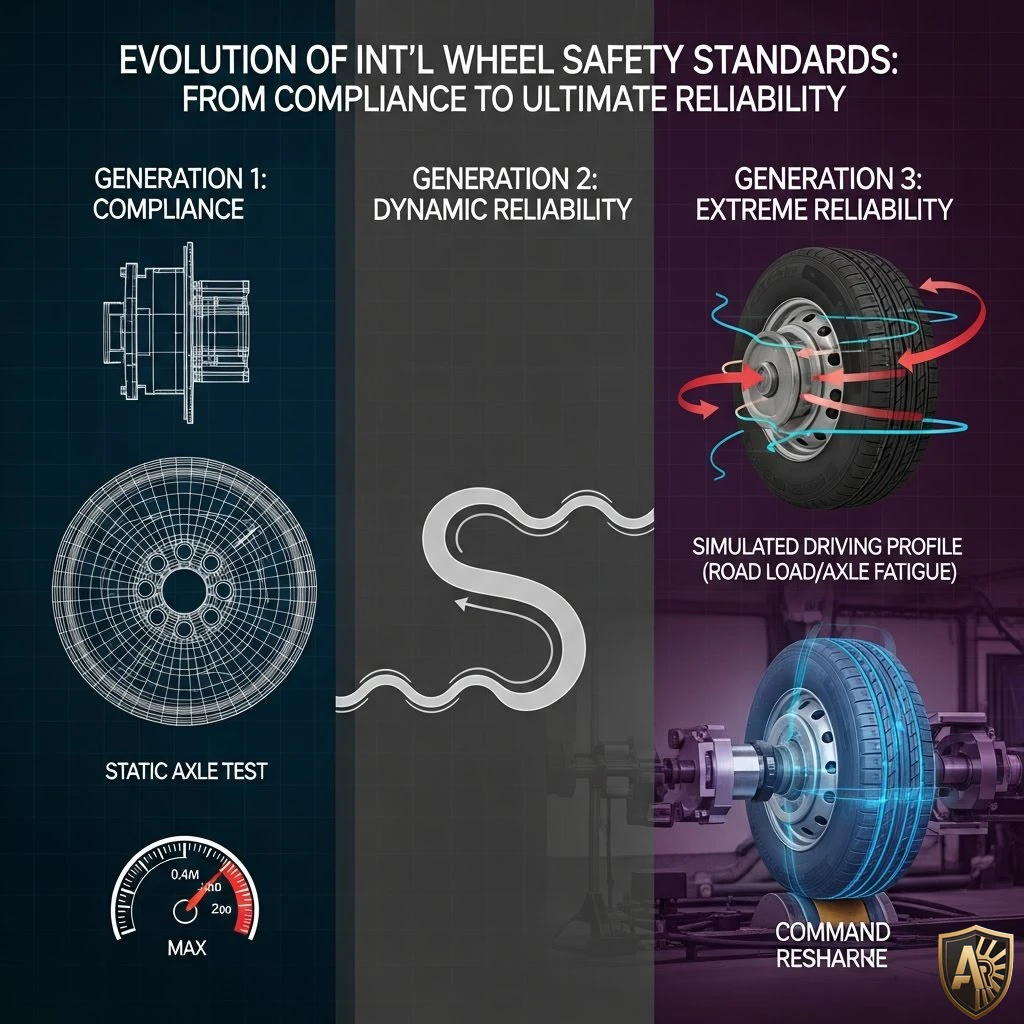
Generation 1: Static & Basic Compliance
Early safety regulations for wheels were relatively straightforward. The primary concerns revolved around a wheel’s ability to handle static loads and ensure basic dimensional compatibility. This meant verifying that the wheel could support the vehicle’s weight while stationary and fit correctly without interference.
These initial standards were foundational but limited in their scope, primarily addressing fundamental structural integrity under ideal, unchanging conditions. Think of it as ensuring the wheel wouldn’t immediately collapse under the car’s weight—a necessary but insufficient guarantee of safety. The testing was simple: apply a static load, measure deflection, verify dimensions. If the wheel didn’t break or deform excessively, it passed.
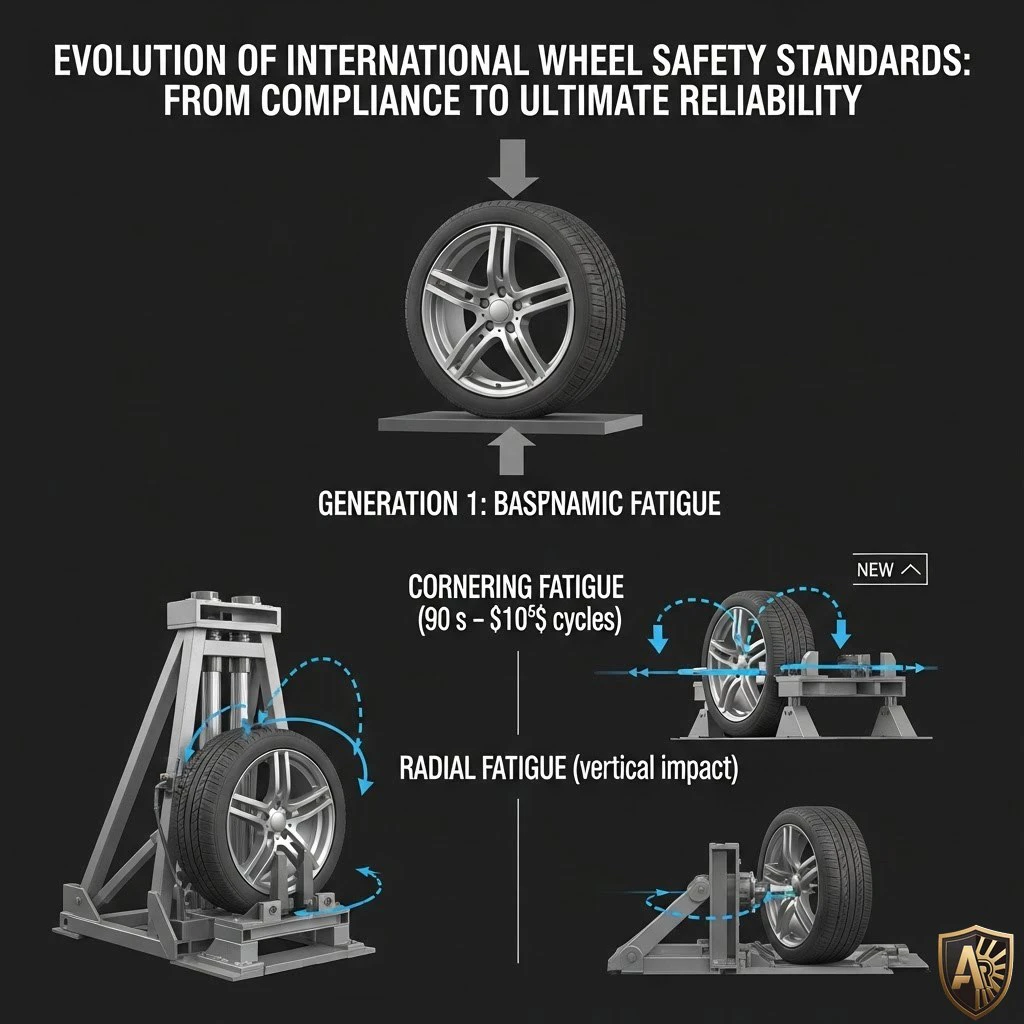
Generation 2: Dynamic Reliability Through Fatigue Testing
As vehicles became faster, heavier, and more sophisticated, it became clear that static tests alone weren’t enough. Wheels needed to prove their durability under the dynamic stresses of actual driving. This led to the emergence of what we can call the “second generation” of wheel safety standards.
Key players like the Department of Transportation (DOT) in the United States and TÜV (Technischer Überwachungsverein) in Germany, Austria, and Switzerland introduced stringent requirements for dynamic fatigue testing. Japan’s JWL (Japan Light Alloy Wheel) standard also became a globally recognized benchmark, despite being a self-certified standard in Japan. To provide third-party assurance, the VIA (Vehicle Inspection Association) certification emerged, offering rigorous external verification for wheels claiming JWL compliance.
Key Dynamic Testing Requirements
These second-generation standards mandated specific tests to simulate real-world forces:
- Cornering Fatigue Test (Rotary Bending / Bending Moment Fatigue): This test simulates the alternating stresses a wheel experiences during cornering and turning. Wheels are mounted on a machine and subjected to millions of cycles of bending moments, often ranging from 105 to 106 cycles, to ensure they don’t develop structural weaknesses or cracks under repeated lateral forces
- Radial Fatigue Test: Designed to mimic the vertical impacts and constant loading a wheel endures as a vehicle moves over varied terrain. In this test, a constant radial load is applied to the rotating wheel, simulating the weight of the vehicle and passengers to prevent the wheel’s spoke structure from failing over long-term use
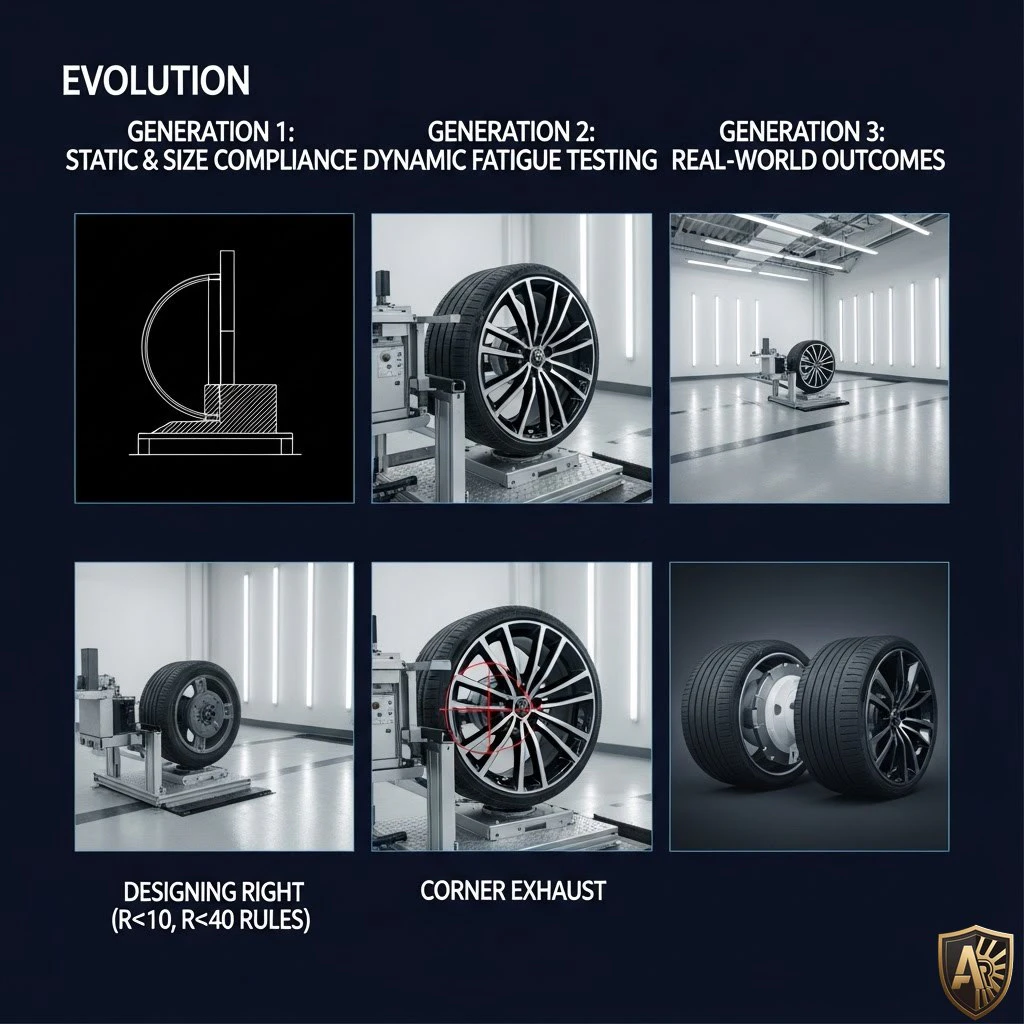
Comparative Standards Analysis
Note the significant difference in cycle requirements: VIA demands up to 4× more cycles than DOT or JWL, while TÜV maintains a middle ground with external auditing that makes it one of the most respected certifications globally.
Generation 3 Challenges: Real-World & Extreme Scenarios
Today, safety regulations are advancing into what many call the “third generation.” The focus is moving beyond purely simulated laboratory conditions to scrutinize real-world performance and extreme operational scenarios. This reflects the increasing complexity of modern vehicles, from electric vehicles with instant torque to high-performance cars and the demands of everyday urban and highway driving.
The shift to Generation 3 standards acknowledges a critical truth: passing a laboratory test doesn’t guarantee real-world safety. Wheels must survive not just predictable stress patterns, but the chaotic, multi-axial loading of actual roads, emergency maneuvers, and environmental extremes.
Advanced Generation 3 Requirements
Modern and emerging standards are beginning to incorporate:
- Run-Flat Performance: This critical development demands that the wheel and tire system work in conjunction to allow a vehicle to continue driving safely for a limited distance and speed even after a tire puncture or complete loss of air pressure. This might mean maintaining controlled driving at speeds up to 80 km/h for a range of 30 km, allowing drivers to reach a safe location rather than being stranded. Wheels designed for run-flat tires often feature specific profiles or support rings to work with the reinforced tire sidewalls
- Thermo-Mechanical Coupling Analysis: As braking systems become more powerful and vehicles generate more heat, especially during sustained high-intensity braking or under heavy loads, the thermal effects on wheel materials become crucial. This advanced analysis evaluates a wheel’s structural stability under the combined and interacting effects of significant temperature increases (from braking friction, which can exceed 300°C) and external mechanical stresses, ensuring the material integrity is maintained in extreme conditions
- Multi-Axial Loading Simulation: Real-world driving involves simultaneous forces from multiple directions—lateral cornering forces combined with vertical impacts and longitudinal braking loads. Generation 3 testing attempts to replicate these complex stress states rather than testing each force independently
- Environmental Durability: Exposure to road salt, extreme temperature cycling (-40°C to +80°C), UV radiation, and chemical contaminants must not degrade wheel structural integrity over the vehicle’s lifespan
- Pothole Impact Testing: Beyond standard impact tests, modern standards are incorporating high-energy pothole simulations that replicate the most common cause of real-world wheel damage
AegisRim’s Generation 3+ Philosophy
At AegisRim, we don’t wait for standards to mandate excellence—we engineer wheels that exceed even Generation 3 requirements:
- AEGIS GripSafe Technology: Our patented bead retention system transforms catastrophic blowouts into manageable events—a feature no traditional standard even tests for
- 6061-T6 Aerospace Aluminum: Material selection that provides 3-5× superior fatigue resistance compared to standard cast wheels
- Finite Element Analysis (FEA): Every design is computationally validated under thousands of load scenarios before physical prototyping
- North American Testing Conditions: Our wheels are validated specifically for the unique challenges of US and Canadian roads—harsh winters, aggressive summer heat, and diverse terrain
The Pursuit of Extreme Reliability
The ongoing evolution of international wheel safety standards is a clear testament to the automotive industry’s relentless pursuit of “passive safety” and “extreme reliability.” What started with basic static checks has transformed into a comprehensive regime of dynamic, real-world, and even extreme scenario testing.
This progression places significant demands on manufacturers. It requires more than just meeting a checklist; it necessitates adopting highly precise engineering designs, utilizing advanced materials, and implementing even more stringent internal and external testing processes. Only through this commitment can the industry truly meet the complex and ever-increasing safety demands of future roads.
At AegisRim, we embrace this challenge. Our wheels aren’t just compliant—they represent the ultimate reliability that Generation 3 standards aspire to achieve. Because when your safety depends on the four contact patches beneath your vehicle, “good enough” has never been in our vocabulary.