Tire Blowout Safety & the Critical Golden Rescue Window with AEGIS GripSafe
Why milliseconds matter in blowout control — and how GripSafe’s mechanical lock delivers superior safety during the most dangerous moments on the road.
A tire blowout is more than a flat: it’s a sudden breakdown in the balance of forces that keep your vehicle stable. In the first few critical seconds — the “golden rescue time” — the driver’s ability to keep the vehicle predictable and under control defines whether the incident ends safely or turns catastrophic.
Traditional run-flat concepts attempt to provide post-failure mobility, but often sacrifice handling and lateral control. AEGIS GripSafe approaches this challenge fundamentally differently — by mechanically locking the tire bead and preserving tire-to-rim engagement the instant pressure drops.
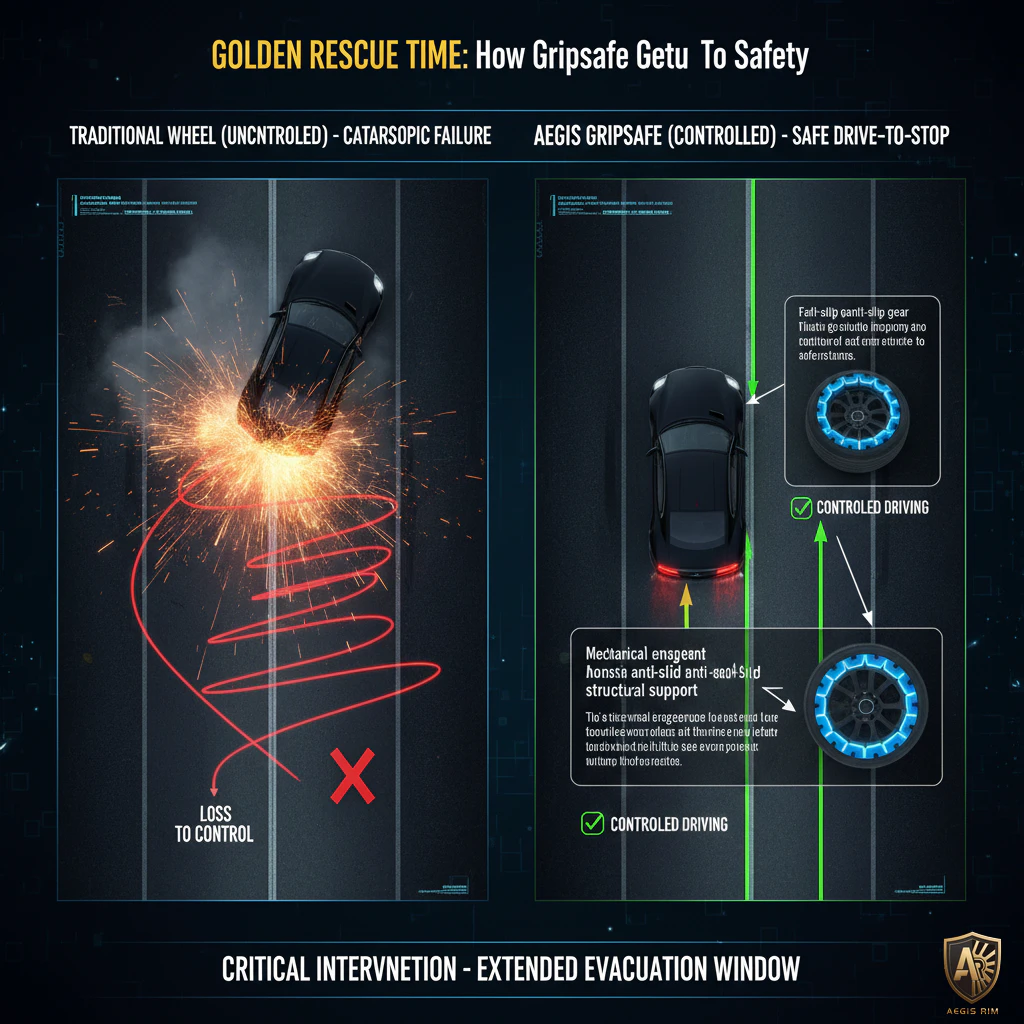
The Golden Rescue Window: Why Seconds Matter
Immediately after a blowout, lateral forces become imbalanced and tire contact diminishes. Within the first few seconds, the vehicle transitions from predictable grip to chaotic drift. This “golden rescue window” is when a driver has the best chance to regain composure and steer the vehicle toward safety.
Traditional run-flat systems delay wheel collapse but often do not sufficiently maintain predictable lateral control — leading to unsafe handling precisely when it matters most.
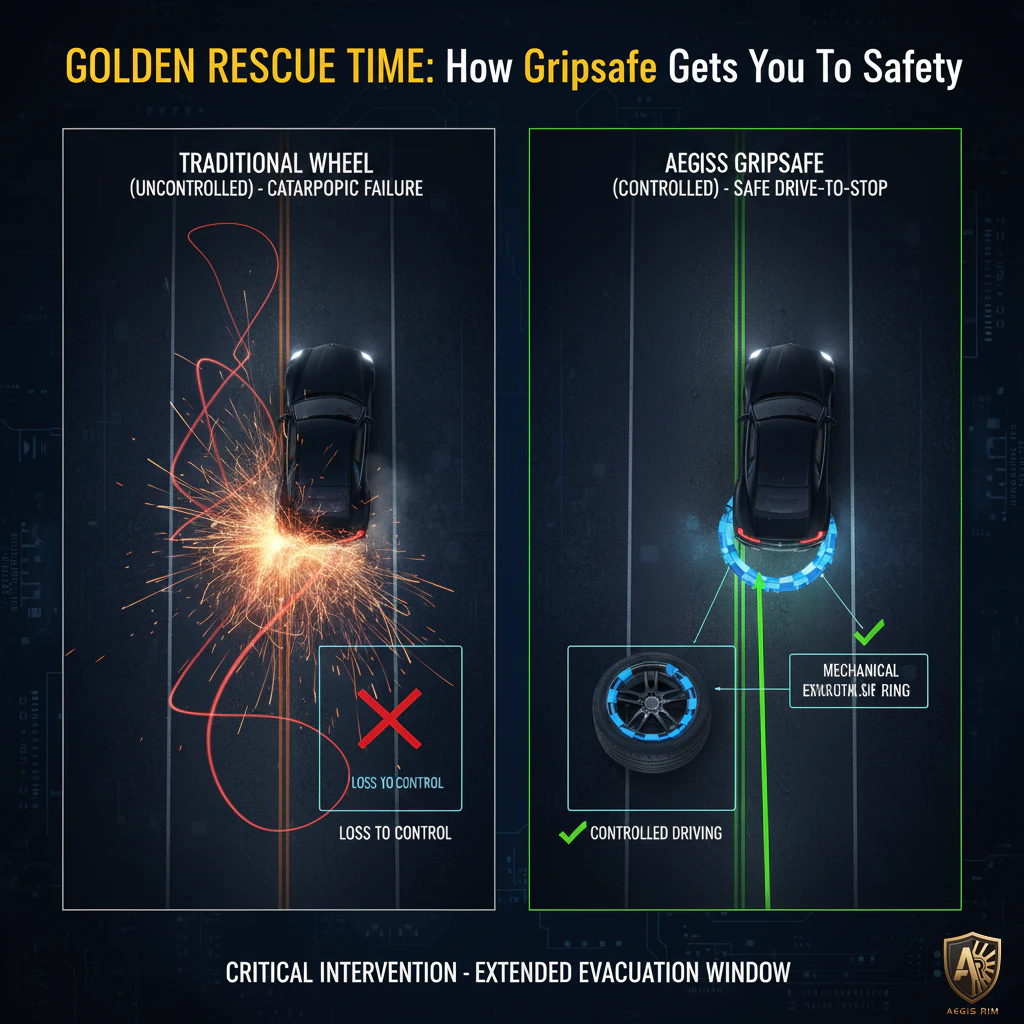
Mechanical Lock vs Passive Support
Unlike passive support rings or bulky run-flat inserts that rely on post-failure structure, GripSafe engages mechanically at the moment of pressure loss. This minimizes bead slip and maintains tire-to-rim contact, allowing the tire to behave in a more predictable way during the critical moments after failure.
This tangible mechanical advantage gives drivers **precious milliseconds** of controlled response — often the difference between an emergency stop in the lane and a safe maneuver toward a shoulder or exit.
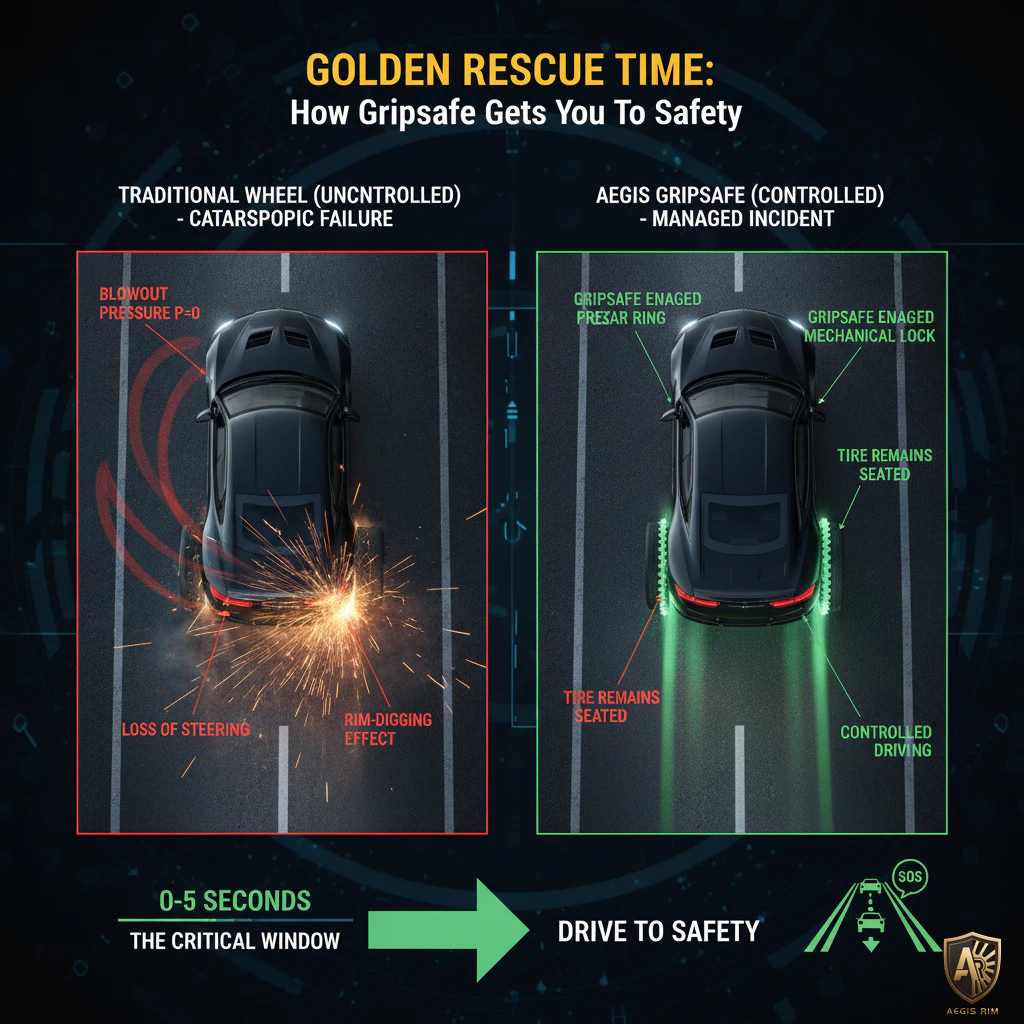
Controlled Safety Drive: Real Outcomes
With GripSafe’s bead lock engaged, the tire maintains predictable lateral behavior. Combined with driver input — steering, throttle modulation, and lane positioning — the vehicle moves toward a safe location instead of spinning out of control. This controlled drive capability is the true safety advantage.
In real-world scenarios, this means more time and distance to navigate away from high-speed traffic, reach a rest area, or find emergency services—all while maintaining composure and vehicle stability.
The golden rescue time after a tire blowout is short, unpredictable, and unforgiving. By preserving mechanical engagement and reducing sudden instability, AEGIS GripSafe extends that window — giving drivers a real chance to control the outcome.
For performance and safety on American roads, engineering that works when physics fails isn’t optional — it’s essential.