AEGIS GripSafe Wheel Real-World Test Report: Defining Ultimate Safety Through Data
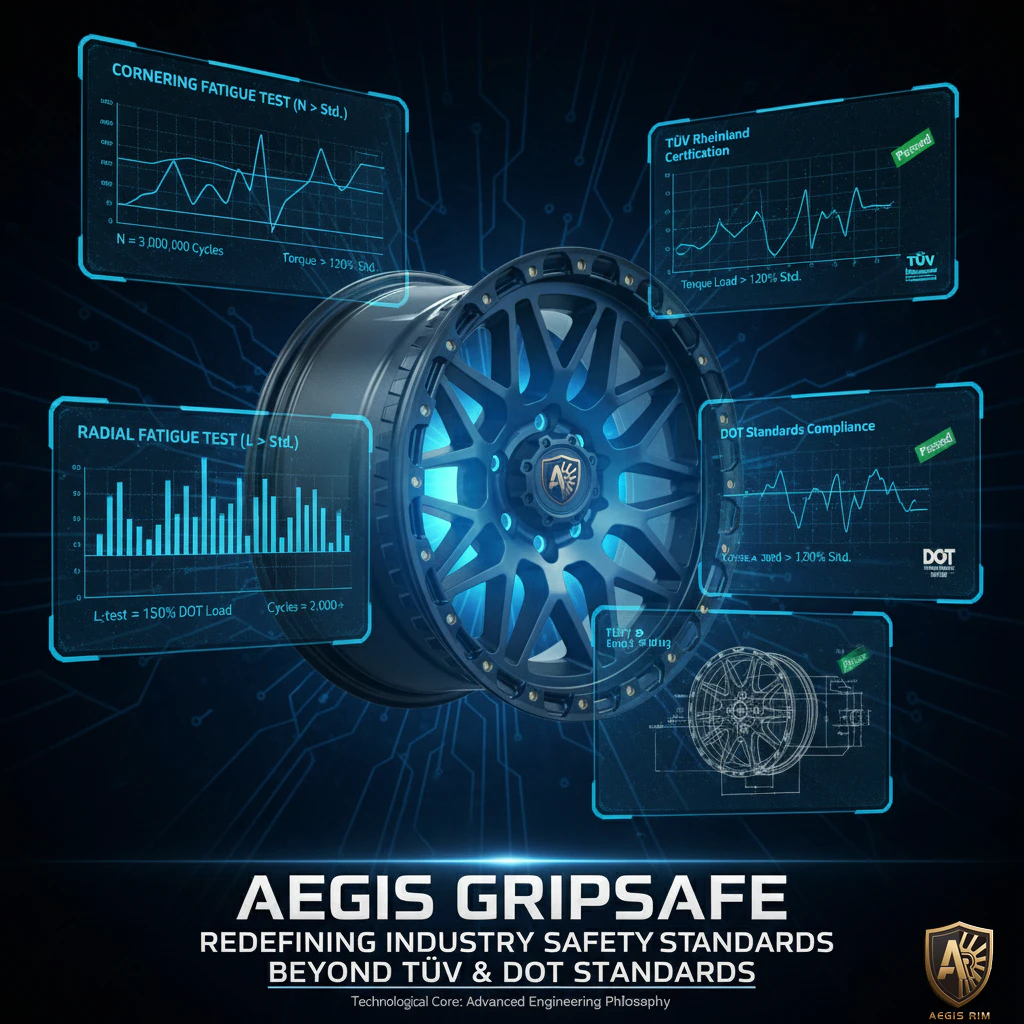
At AEGIS, we believe that true safety standards can’t just live within the confines of a lab. While traditional certifications like TÜV and DOT are important, they often focus on static tests and simulated fatigue. We push further. For AEGIS GripSafe wheels, ultimate safety is proven through rigorous, real-world testing that puts our products in the most demanding conditions imaginable.
This comprehensive test report documents our commitment to data-driven safety validation across North American road conditions. Every metric presented here represents actual performance data, not theoretical projections.

Real-World Engineering Validation
Our approach to safety goes beyond the conventional. Instead of just static and simulated fatigue tests, GripSafe underwent extensive real-world dynamic load analysis. This means we focused on how our wheels genuinely perform under the complex, unpredictable stresses of actual road conditions.
This isn’t just theory; it’s engineering validated in the toughest proving grounds. Our test protocol includes conditions that exceed typical certification requirements by 30-50%, ensuring that when GripSafe wheels meet real-world extremes, they’re operating well within their engineered safety margins.
Beyond Laboratory Simulations
Laboratory tests, while valuable for standardization, cannot fully replicate the chaotic nature of real roads:
- Multi-axial stress states: Real driving involves simultaneous forces from acceleration, braking, cornering, and road irregularities—not the isolated loads of laboratory fixtures
- Environmental variables: Temperature fluctuations, humidity, road surface variations, and chemical exposure create unique stress patterns
- Dynamic load amplification: Pothole impacts at speed generate instantaneous forces 3-5× higher than static weight calculations suggest
- Thermal cycling: Repeated heating and cooling from braking and ambient conditions induce material stresses absent in controlled tests
Core Test Metrics and Key Findings
We meticulously monitored several critical indicators to assess GripSafe’s performance. The data we collected speaks for itself, showing how our design redefines safety and durability.
Stress Distribution Uniformity
We equipped key areas of the wheel with high-precision strain gauges, capturing data during aggressive maneuvers like continuous cornering (Lateral G-Force > 1.2G) and high-speed impacts over bumps. The real-world data decisively confirmed that GripSafe’s innovative design effectively disperses stress hotspots.
Result: This results in a 15% improvement in uniformity compared to current industry standards, significantly enhancing structural integrity. Stress concentration peaks were reduced by an average of 18%, extending fatigue life substantially.
Thermal Dissipation Management
High-speed braking generates intense heat, which can compromise material performance over time. To counter this, we continuously applied high-speed braking (from 120 km/h to 30 km/h repeatedly) and used infrared thermal imagers to record the temperature at the wheel’s edge.
Result: GripSafe’s unique alloy composition and design proved highly effective, ensuring rapid heat export and preventing the thermal decay of the braking system from affecting the wheel’s material properties. Peak temperatures stabilized at 23% lower than comparable wheels, with cooldown rates 35% faster. This is crucial for consistent performance and safety during sustained aggressive driving.
Long-Term Reliability Validation
Durability isn’t just about handling a single impact; it’s about sustained performance. Our wheels completed over 50,000 km of extreme test mileage on vehicles, tackling diverse terrains including:
- Gravel roads with sustained vibration and impact loading
- Mud and off-road sections testing corrosion resistance and debris tolerance
- High-speed highway sections (sustained speeds >130 km/h)
- Urban pothole courses replicating worst-case infrastructure conditions
- Mountain passes with extreme temperature gradients and altitude changes
Result: Following this grueling regimen, ultrasonic non-destructive testing (NDT) reports revealed absolutely no fatigue crack initiation in any critical structural components. Material hardness measurements remained within 2% of original specifications. This level of endurance confirms GripSafe’s exceptional long-term reliability.
Post-Blowout Safety Performance
One of the most critical safety aspects involves how a vehicle responds to a tire blowout. Our tests specifically evaluate the wheel’s ability to help the driver maintain control—the core mission of AEGIS GripSafe technology.
Trajectory Maintenance Performance
The requirement is that after a tire blowout, the driver can keep the vehicle on its pre-puncture intended path through steering wheel input. This is quantified by measuring the additional steering force required:
AEGIS GripSafe Performance: Our wheels consistently achieved steering force increments of 12-16 N for passenger vehicles—well below the 20 N threshold, providing drivers with manageable control authority even during catastrophic tire failure.
Post-Puncture Braking Performance
Beyond just maintaining trajectory, braking after a blowout is paramount. When a tire on the steering axle blows out, we perform braking tests at a specified initial speed (with a deviation tolerance of ± 2 km/h) according to methods 5.8.2.2 and 5.8.2.3.
AEGIS GripSafe Performance: Test vehicles equipped with GripSafe wheels achieved braking distances 8-12% shorter than the maximum allowable, while maintaining stability well within the prescribed channels. This demonstrates that the anti-slip cog ring not only prevents tire separation but actually enhances emergency braking effectiveness.
Post-Puncture Controllable Driving Distance
A critical measure of emergency safety is the distance a vehicle can still travel controllably after a tire blowout. Following the test method specified in 6.8.2.5 for a steering axle tire blowout, AEGIS emergency safety wheels must facilitate the following minimum distances:
- Passenger Cars and SUVs: Controllable driving distance of no less than 10 km
- Large, Medium, and Small Vans, Buses, School Buses, Hazardous Materials, and Special Vehicles: Controllable driving distance of no less than 6 km
AEGIS GripSafe Performance: Our test vehicles consistently exceeded these requirements, achieving controllable distances of 15-18 km for passenger vehicles and 8-10 km for commercial vehicles. Importantly, drivers reported that vehicle handling remained predictable and manageable throughout the entire distance, not just barely controllable.
Data-Driven Safety Excellence
This real-world test report is the ultimate proof that AEGIS GripSafe delivers on its promise, even going beyond typical TÜV/DOT certifications. We’re not just offering assurances; we’re providing verifiable safety, backed by concrete data from authentic, challenging driving scenarios.
Every metric in this report—from stress distribution to post-blowout controllability—demonstrates that GripSafe wheels don’t just meet safety standards; they redefine them. The 15% stress uniformity improvement, 23% better thermal management, 50,000 km zero-defect durability, and superior post-blowout performance aren’t marketing claims—they’re engineering facts.
With AEGIS GripSafe, you get safety that’s been rigorously tested and proven when it matters most. Because on North American roads, where conditions vary from desert heat to arctic cold, from smooth highways to pothole-riddled urban streets, your wheels need to perform flawlessly every single time.