Blowout Survival: Tunnels, Bridges & Why AEGIS GripSafe Matters
How physics changes in enclosed and elevated environments — and how AEGIS GripSafe bead lock technology gives drivers a critical advantage after tire pressure loss.
A tire blowout is a dynamic event. But when it happens in a tunnel or on a bridge, that dynamic interacts with environmental constraints — leaving drivers with less reaction time and fewer escape options. The combination of confined space, elevated road geometry, and aerodynamic influences creates a unique hazard profile that demands engineered solutions, not guesswork.
AEGIS GripSafe was designed from the ground up to preserve mechanical bead engagement, maintain predictable tire-to-road contact, and help drivers keep control when physics pushes them to the limit.
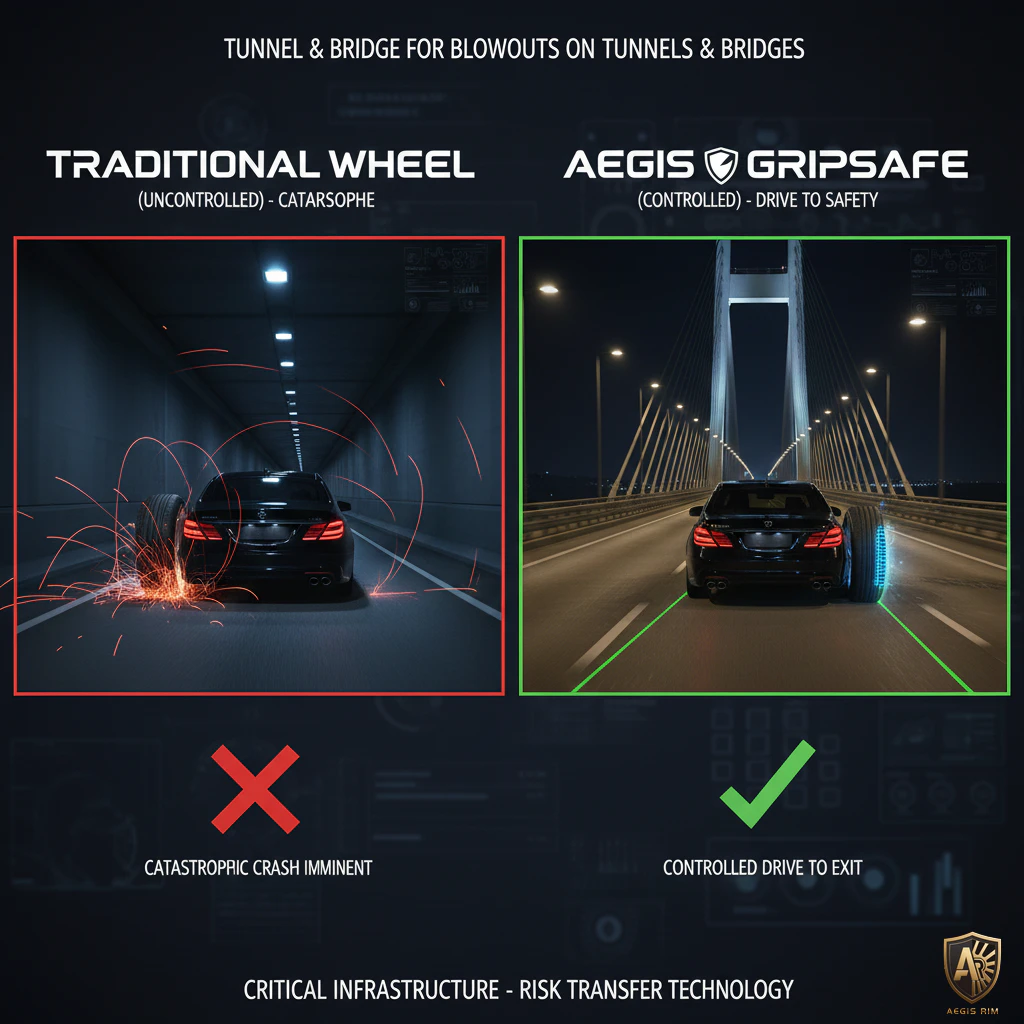
Why Enclosed & Elevated Road Sections Increase Risk
Tunnels and bridges can amplify the effects of a blowout. Narrow lanes limit maneuverability, while lateral crosswinds on bridges add unpredictable forces. Confined concrete walls can reflect sound and vibration, escalating driver stress. All these factors reduce reaction time for corrective steering.
When lateral force imbalance occurs after a pressure loss, the environment matters. Limited escape space and elevated structures elevate the consequences of loss of control.
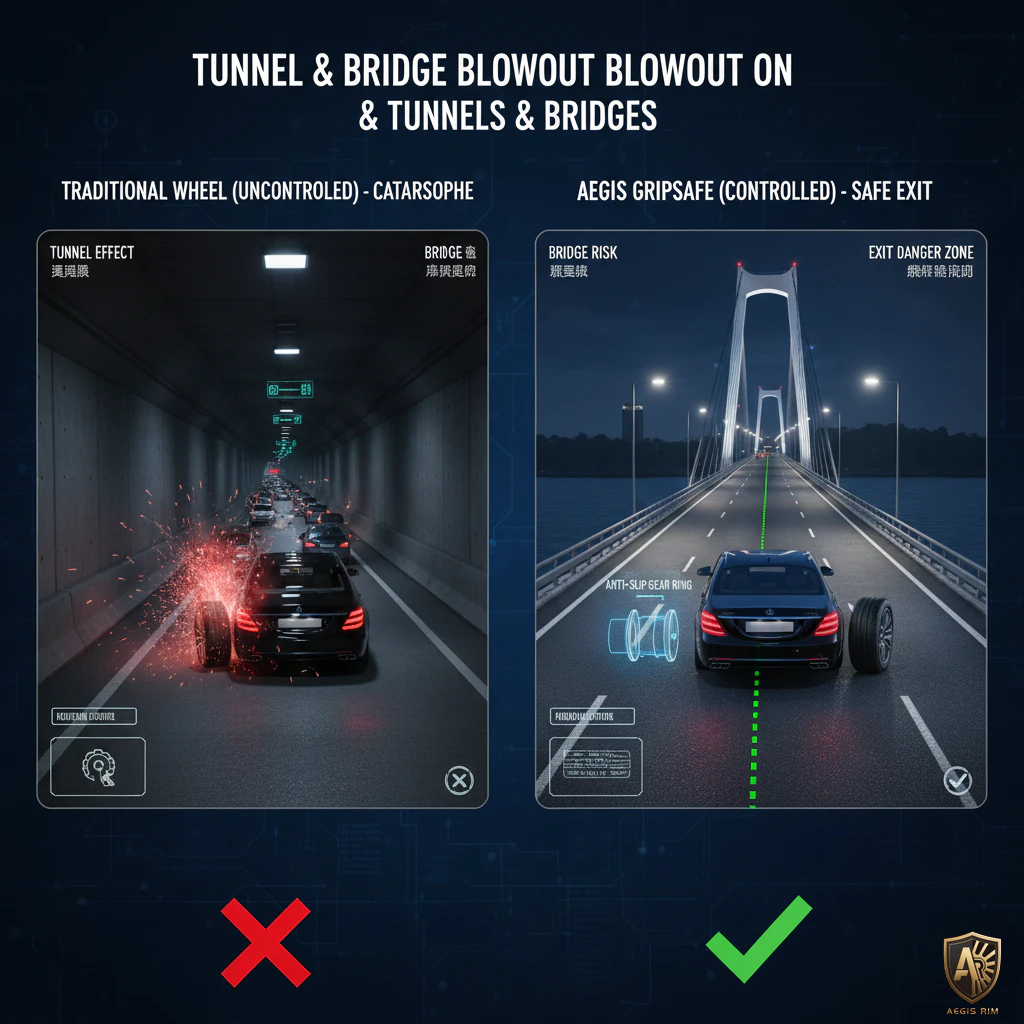
Blowout Physics in Confined Spaces
In a confined section like a tunnel, aerodynamic pressure builds differently than in open air. Side forces and reflected airflow can push against the vehicle unpredictably. An abrupt change in tire contact — as happens in a blowout — means the differential forces have less room to dissipate.
Traditional wheels may experience bead slip or loss of contact patch in those moments, creating a sudden lateral imbalance. GripSafe’s mechanical bead lock maintains interface engagement and minimizes this imbalance.
Controlled Driving vs Loss of Control
During a blowout on a bridge or tunnel, the best possible outcome is a controlled path to a safe exit, not an immediate stop in the lane. GripSafe enables the driver to maintain predictive steering and use throttle modulation to balance speed, lane position, and lateral forces — even with compromised tire pressure.
This engineered control can be the difference between avoiding a collision and becoming part of one.
Surviving a blowout is more than just keeping the car upright — it’s about maintaining control until the environment becomes safe again. In complex scenarios such as tunnels and bridges, the stakes are higher and the margin for error is lower.
With AEGIS GripSafe Technology, drivers gain a predictable response and enhanced stability that significantly reduces the risk of secondary crashes or dangerous deviations — especially on the highways of the United States.