The Deadly Detachment: Why Standard Rims Lose Control During Blowouts
In our last post, we introduced Gripsafe Technology. Now, let’s dive into the critical flaw in conventional wheel design that makes high-speed blowouts so terrifying: Bead Unseating.
Every driver faces a critical, life-threatening risk: When your vehicle experiences a sudden tire blowout on the highway, the design of standard wheel rims is precisely what escalates the danger.
What is “Bead Unseating”?
Standard wheel rims rely entirely on the air pressure within the tire to force the tire’s edge—the bead—firmly against the rim flange. When a catastrophic pressure loss occurs (a blowout), this support instantly vanishes.
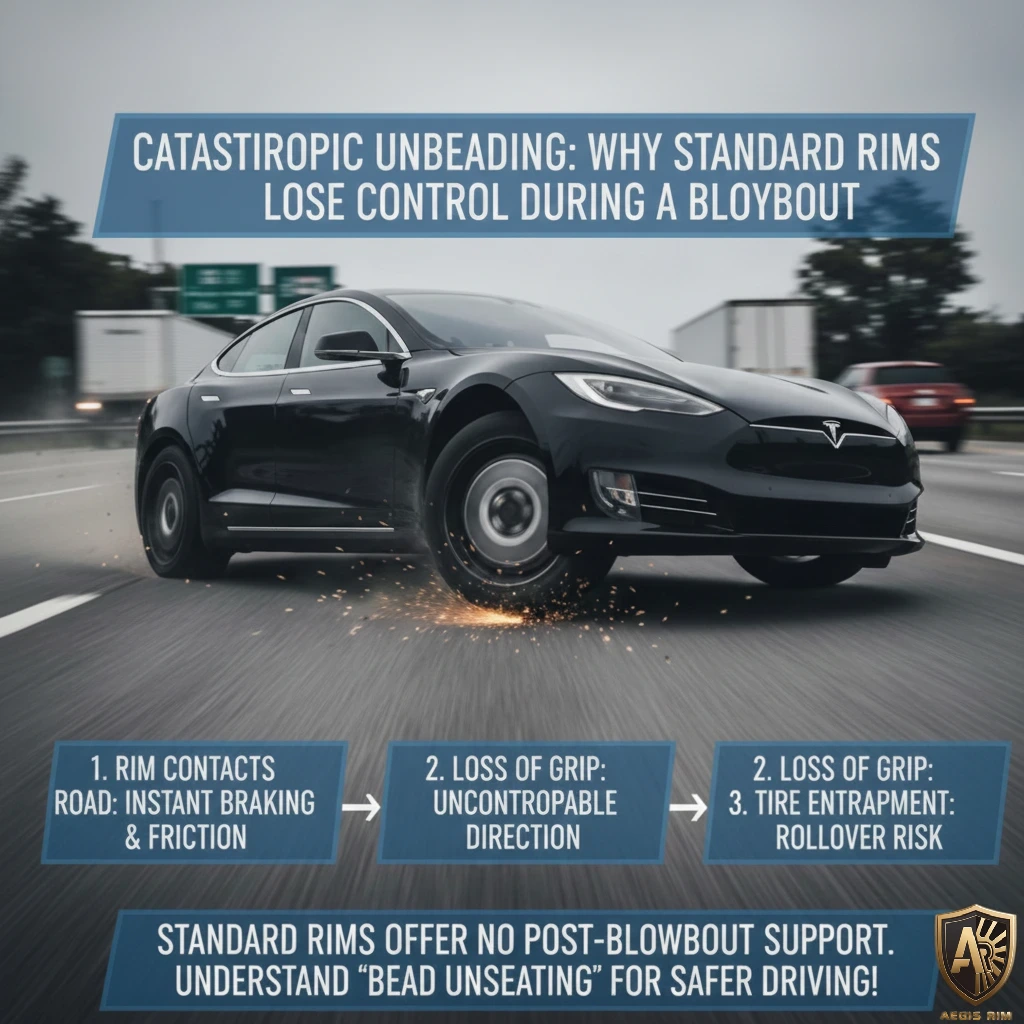
Under the powerful forces of impact and deflation, the tire bead separates, or unseats, from the rim edge and collapses into the center of the wheel barrel. Once unseating occurs, the chain reaction to disaster begins:
- Instantaneous Braking & Friction: The rim’s metal lip drops and makes direct, uncontrolled contact with the road surface. This causes immediate, violent braking on that specific wheel, throwing the car into an unpredictable yaw.
- Catastrophic Loss of Grip: The sudden, uneven braking force and the change in weight distribution lead to a rapid loss of steering control. The driver is instantly fighting a vehicle that is dictating its own, dangerous direction.
- Tire Entrapment and Rollover Risk: The loose, deflated rubber gets trapped and bunched up between the rim and the road. This severely compromises the vehicle’s stance, drastically increasing the risk of a severe swerve, side impact, or—in high-profile vehicles—a catastrophic rollover.
The Cold Truth
Standard rims offer no structural support or retention capability post-blowout. Understanding this “Bead Unseating” risk is the first step toward demanding a safer wheel design.
Now that you understand the deadly flaw in conventional wheel design, discover how Gripsafe Technology eliminates bead unseating and keeps you in control when it matters most.