Aftermarket Wheel Safety Blind Spots: Why Custom Rims May Be Less Safe Than You Think
Custom wheels can dramatically transform your vehicle’s appearance and performance—but they can also introduce serious safety risks that most enthusiasts never consider. The aftermarket wheel industry is filled with critical safety blind spots that put drivers at risk every day on North American roads.
At AegisRim, we believe informed decisions save lives. This article exposes the three most dangerous blind spots in aftermarket wheel selection—and explains how to protect yourself from catastrophic failures that the industry rarely discusses openly.
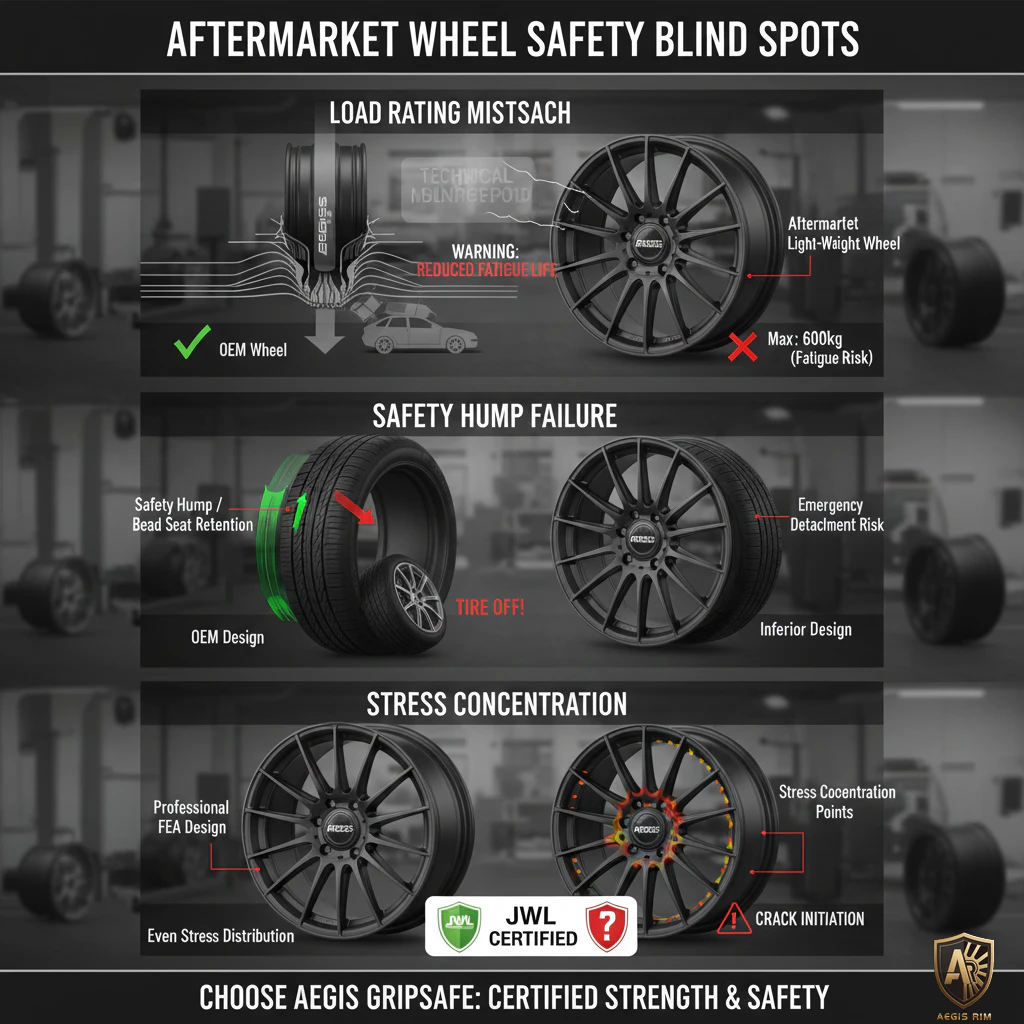
Blind Spot #1: Hidden Fatigue Risk from Manufacturing Quality
The most dangerous blind spot in aftermarket wheels is one you literally cannot see: internal material fatigue. While a wheel may look pristine and pass visual inspection, microscopic defects from manufacturing can create time bombs waiting to fail catastrophically.
Cast vs. Forged: The Invisible Difference
Most aftermarket wheels use low-pressure casting or gravity casting methods to reduce costs. These processes create wheels with:
- Porosity: Microscopic air pockets trapped in the metal during casting weaken structural integrity by 20-40%
- Grain Structure Defects: Random grain orientation creates stress concentration points that propagate cracks under cyclic loading
- Inconsistent Wall Thickness: Variations of ±15-30% create unpredictable weak points
- Inclusions and Contaminants: Foreign particles in the melt create initiation sites for fatigue cracks
The AegisRim Solution: Our forging process eliminates porosity, aligns grain structure for maximum strength, and ensures ±2-3% wall thickness consistency. The result? Fatigue life that’s 3-5× longer than cast alternatives.
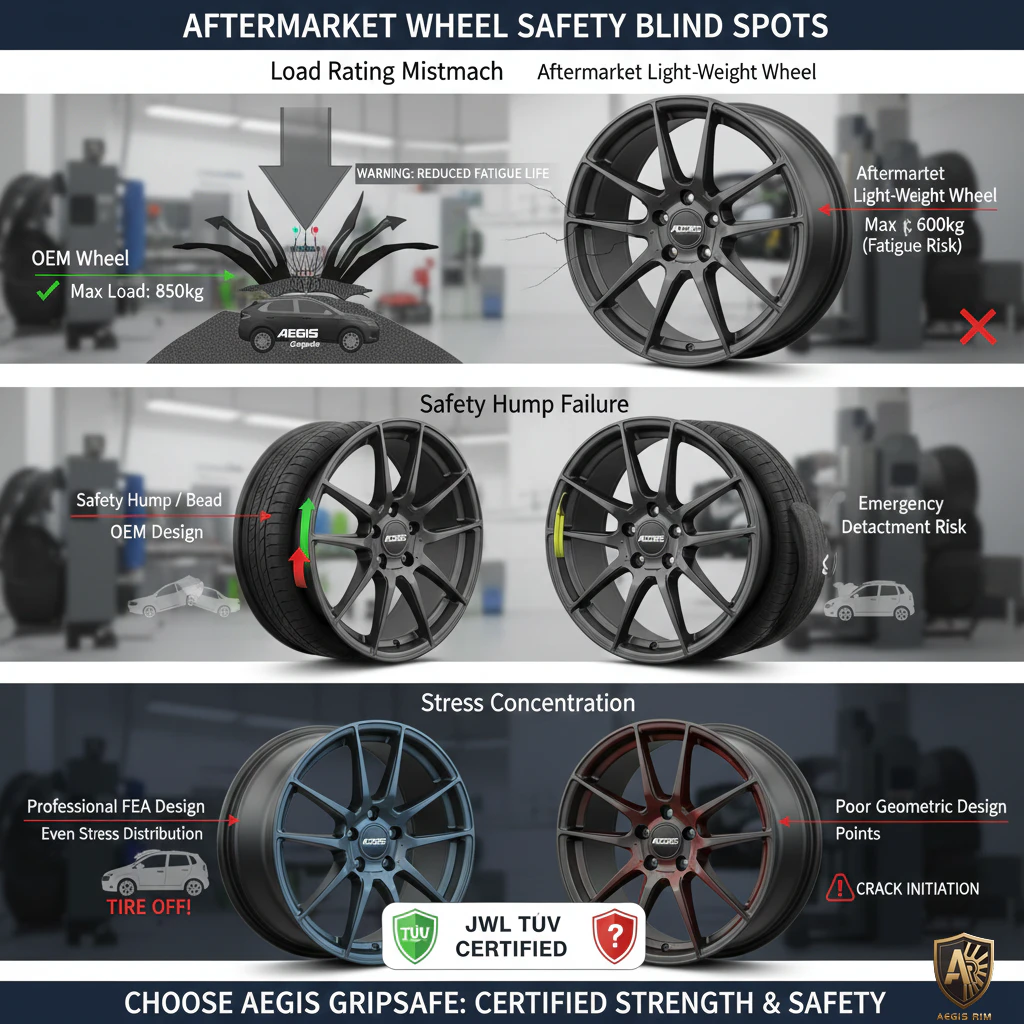
Warning Signs You’re at Risk
Unfortunately, fatigue failures often occur without warning. However, these indicators suggest your wheels may be at risk:
- Vibration that appears after 20,000-30,000 km, even with proper balancing
- Hairline cracks visible near spoke bases or mounting holes
- Paint flaking in stress areas (indicates flexing beyond design limits)
- Wheels purchased primarily on price rather than certification and reputation
- No documentation of TÜV, VIA, or equivalent third-party testing
Blind Spot #2: Load Rating Mismatch and Installation Errors
The second critical blind spot is one of the most common yet least understood: improper load rating selection. Many enthusiasts choose wheels based on appearance, assuming that if a wheel physically fits, it’s safe to use. This assumption kills people.
Understanding Load Rating Requirements
Your vehicle’s GAWR (Gross Axle Weight Rating) determines the minimum wheel load capacity required. However, calculating proper load ratings involves more than simple division:
Critical Error: Many aftermarket wheels designed for passenger cars are incorrectly installed on SUVs or trucks. A wheel rated for 650 kg will eventually fail when subjected to 900+ kg loads—it’s not a matter of if, but when.
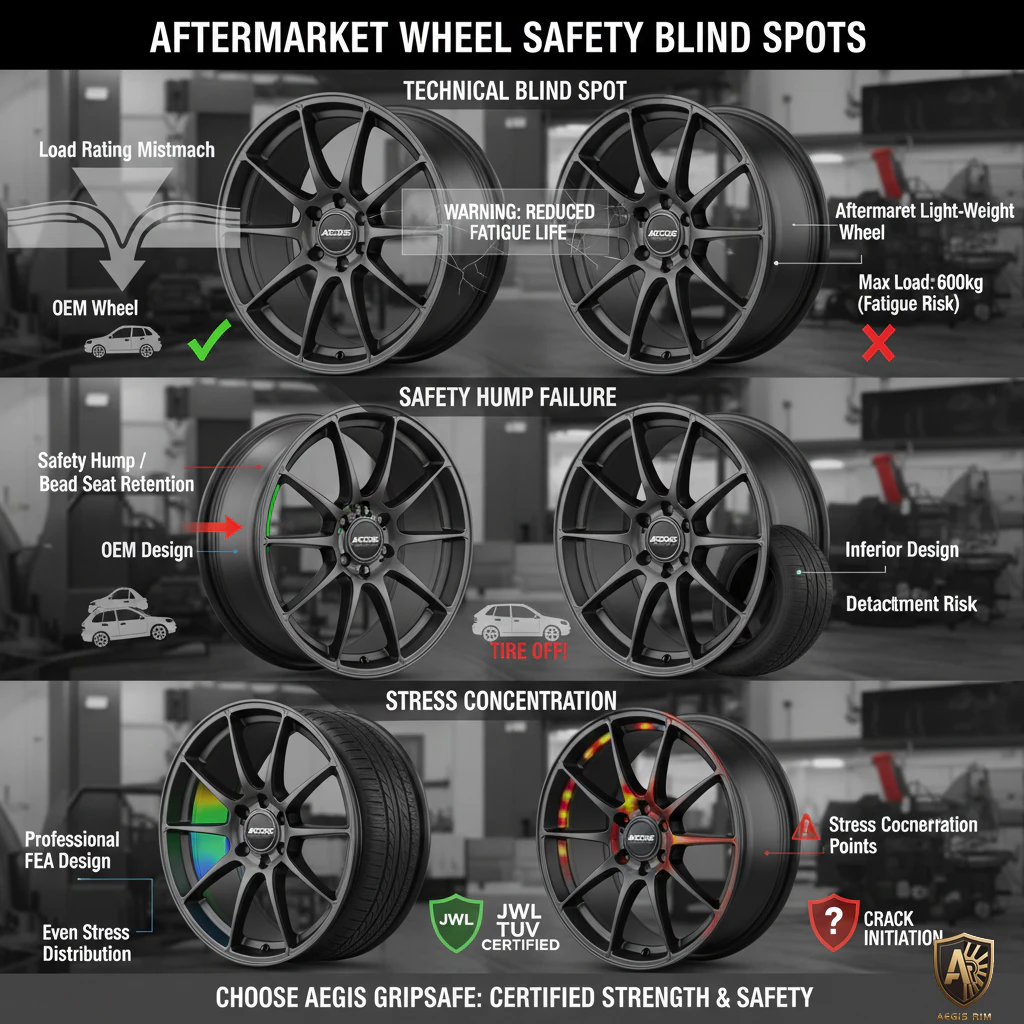
Installation Errors That Compromise Safety
Even correctly rated wheels can fail due to improper installation:
- Incorrect Torque: Over-tightening causes stress risers; under-tightening allows movement and fretting. Proper torque: 100-140 Nm for most applications
- Wrong Lug Hardware: Conical vs. ball vs. flat seat mismatches create point loads that crack wheels
- Hub-Centric vs. Lug-Centric: Non-hub-centric wheels without proper centering rings cause vibration and accelerated wear
- Improper Offset: Excessive offset changes suspension geometry and increases bearing loads by 30-50%
AegisRim Difference: We provide complete fitment specifications, proper hardware, and detailed installation instructions for every wheel. Our technical support team verifies compatibility before any order ships.
Blind Spot #3: Absence of Real-World Safety Testing
The third and perhaps most insidious blind spot is the certification gap. Many aftermarket wheels claim “DOT approved” or display certification marks, but the reality is more complex and dangerous than most consumers realize.
The Certification Confusion
Understanding wheel certifications requires knowing what’s actually being tested:
The Problem: Wheels can display “DOT” markings with minimal actual testing. There’s no mandatory third-party verification, no ongoing quality audits, and no enforcement unless failures occur. You’re trusting the manufacturer’s self-reported compliance.
What Comprehensive Testing Actually Involves
AegisRim wheels undergo testing that exceeds all standard certifications:
- Cornering Fatigue: 2-3 million cycles vs. 500k standard (400-600% longer)
- Radial Fatigue: 130-150% of rated load for extended duration
- Impact Testing: 3× DOT requirement at multiple angles
- Real-World Validation: 50,000+ km on test vehicles across diverse terrains
- NDT Inspection: Ultrasonic and X-ray inspection of production samples
How to Protect Yourself: Due Diligence Checklist
Before purchasing any aftermarket wheels, verify these critical safety factors:
- Manufacturing Process: Confirm forged (not cast) construction with documentation
- Load Rating Verification: Calculate required capacity; add 30-100% safety margin depending on use
- Third-Party Certification: Demand TÜV or VIA certification, not just DOT/JWL claims
- Manufacturer Track Record: Research company history, warranty claims, and incident reports
- Complete Fitment Data: Ensure proper offset, center bore, and hardware specifications
- Professional Installation: Use torque wrenches, proper hardware, and hub-centric rings
- Regular Inspection: Check for cracks, vibration, or unusual wear every 5,000 km
Don’t Gamble with Safety
The aftermarket wheel industry’s three critical blind spots—hidden fatigue risk, load rating mismatches, and inadequate testing—create genuine dangers that claim lives every year on North American roads. These aren’t theoretical risks; they’re documented failure modes that kill people.
At AegisRim, we’ve built our reputation on eliminating these blind spots through superior engineering, rigorous testing, and transparent communication. Every wheel we manufacture represents our commitment to your safety—not just regulatory compliance, but genuine protection validated through data.
Your wheels are the only components connecting your vehicle to the road. They experience forces of 3-5× your vehicle’s weight during cornering, endure millions of stress cycles, and must perform flawlessly in conditions from -40°C to +85°C. This isn’t a component to compromise on. Choose wisely. Choose AegisRim.