Mastering Mountain Roads: Precision Control for Cornering Dynamics
Winding mountain roads, with their continuous curves, are the ultimate test of a vehicle’s handling capabilities. When you’re tackling high-speed corners, effectively managing pressure loss in your tires and ensuring consistent traction is absolutely critical. This isn’t just for seasoned drivers; it’s fundamental knowledge for anyone who wants to confidently navigate challenging terrain. At AegisRim, we understand that superior wheels and advanced vehicle dynamics work together to deliver the precision control demanded by North America’s most challenging mountain roads.
The Cornering Challenge: Tire Pressure Loss and Grip Limits
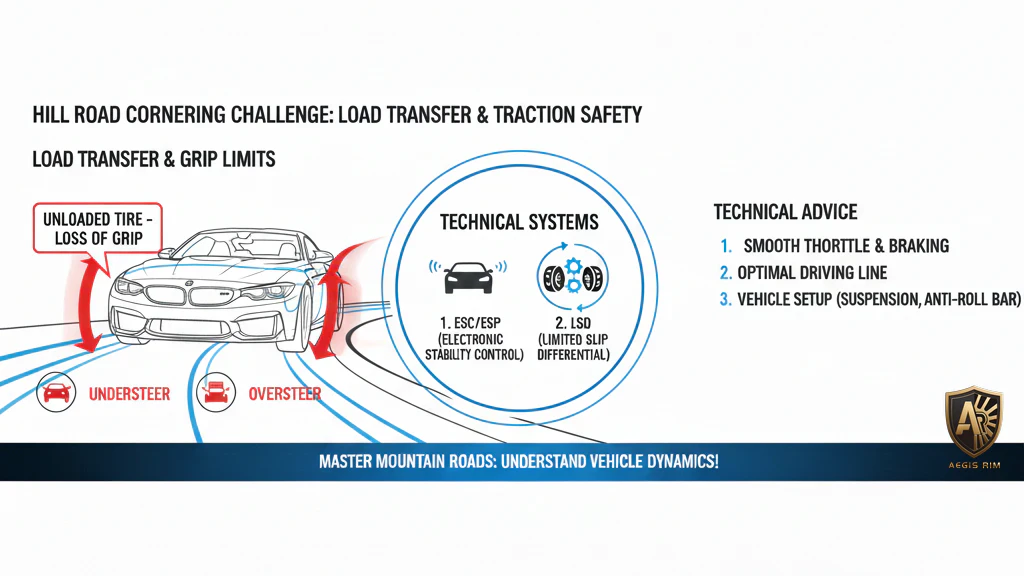
During high-speed cornering, the vehicle’s weight shifts dramatically. This causes the tires on the outside of the turn to bear immense pressure, while the inside tires can momentarily “unload” – a sudden reduction in vertical load, or pressure loss. This weight transfer is governed by physics and happens in every corner, but its effects become critical when pushing performance limits.
When a tire loses this pressure, its grip drops sharply. Even if it doesn’t completely lift off the ground, its adhesion to the road might not be enough to handle the lateral forces. This isn’t just about sluggish steering; it can push the vehicle beyond its grip limits, leading to either understeer (where the car pushes wide) or oversteer (where the rear end slides out). Both scenarios can be dangerous if not managed correctly.
The Physics of Load Transfer
Load transfer during cornering is determined by several key factors that work together to shift weight across your vehicle’s contact patches:
- Center of gravity height: Higher CG increases load transfer magnitude—this is why lowering springs improve handling
- Track width: Wider stance reduces the percentage of weight transfer per unit of lateral G-force
- Cornering speed: Lateral forces increase exponentially with speed—doubling speed quadruples the lateral load
- Suspension geometry: Roll centers and anti-roll bars determine how that weight transfer distributes front-to-rear
Technical Solutions: Advanced Stability Systems
To combat the challenges of pressure loss and maintain traction, modern vehicles rely on sophisticated electronic and mechanical systems. These aren’t just fancy features; they’re vital for keeping your car pointed in the right direction. Understanding how these systems work helps you become a better, more confident driver.
Electronic Stability Control (ESC/ESP)
Electronic Stability Control (often called ESP by some manufacturers) is your car’s digital guardian. It constantly monitors steering angle, wheel speed, yaw rate, and lateral acceleration. When it detects that the vehicle is veering off its intended path, it intervenes by:
- Selectively braking individual wheels: This can help correct oversteer by braking the outer front wheel or counteract understeer by braking the inner rear wheel
- Reducing engine power: Temporarily cutting power can help regain control by reducing the forces trying to push the car wide
- Managing torque vectoring: On advanced systems, power can be redistributed between wheels to enhance cornering stability
Crucially, in situations where an inside tire loses pressure and starts to slip, ESC can apply a gentle brake to that specific wheel. This action not only helps transfer power to the wheels with better grip but also subtly adjusts the vehicle’s attitude, bringing it back into line. Modern ESC systems react in milliseconds—far faster than human reflexes—making them invaluable safety partners on challenging roads.
Limited Slip Differential (LSD)
A Limited Slip Differential is a mechanical or electronically controlled device that manages power distribution between the drive wheels. Its primary function is to prevent one wheel from spinning freely (losing traction) while the other has good grip. This is particularly critical when cornering forces cause load transfer.
Here’s how an LSD helps with pressure loss in corners:
Whether mechanical (clutch-type, Torsen, or viscous) or electronic, an LSD is key to ensuring that engine torque is always put to the ground effectively, even when one wheel isn’t getting enough load. For performance driving on mountain roads, an LSD transforms how your vehicle exits corners—replacing wheel spin with forward thrust.
Practical Driving Advice for Mountain Roads
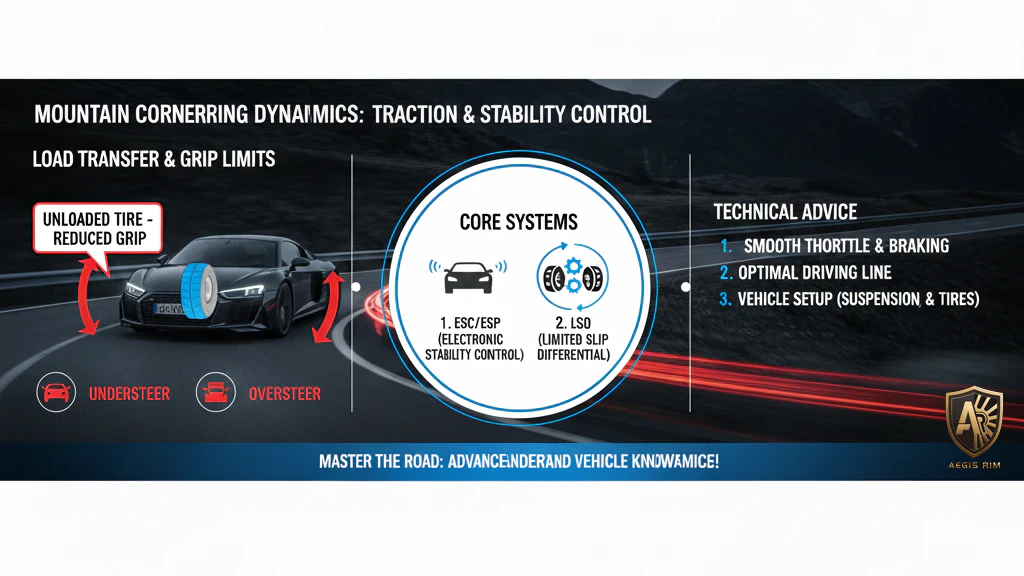
While advanced systems are doing their part, your driving technique is equally important. Combining vehicle technology with skilled driving is how you truly master mountain roads. Here’s how to work with your vehicle’s systems, not against them:
1. Smooth Throttle and Braking
- Brake before the turn: Decelerate sufficiently before entering the corner. Avoid heavy braking mid-corner, which can destabilize the vehicle and trigger excessive load transfer
- Maintain stable throttle mid-corner: Once in the turn, try to maintain a consistent, light throttle input. This helps settle the car and maintain weight distribution, preventing sudden load shifts
- Smoothly accelerate out of the turn: As you exit the corner and straighten the steering, gradually increase throttle. Abrupt acceleration can break traction, especially on the inside rear wheel if you have an open differential
- Trail braking (advanced): For experienced drivers, gradually releasing brake pressure as you turn in can help rotate the car and improve turn-in response, but requires precise control
2. Optimal Driving Line
- Look ahead: Plan your line well in advance. Your eyes should be focused on the exit of the corner, not just the apex
- Minimize G-force fluctuations: Aim for a smooth, arcing line that minimizes sudden changes in lateral G-forces. A common technique is the “late apex,” which allows for earlier power application on corner exit
- Outside-inside-outside: Use the full width of your lane (when safe and legal) to maximize radius and reduce cornering forces
- Reduce time at maximum lateral load: By optimizing your line, you minimize the duration spent at peak cornering forces, reducing the severity of tire pressure loss effects
3. Vehicle Setup and Maintenance
- Suspension stiffness: Appropriately stiff suspension helps control body roll and load transfer, keeping tires more consistently loaded. However, overly stiff suspension can reduce mechanical grip
- Anti-roll bars: These components link opposing wheels and help distribute load more evenly across the axle during cornering, reducing excessive inside wheel unloading
- Tire choice and pressure: High-performance tires with good sidewall stiffness and the correct tire pressures are fundamental. Always ensure your tires are in good condition and inflated to the manufacturer’s recommended specifications
- Wheel quality matters: Lightweight forged wheels like those from AegisRim reduce unsprung mass, allowing suspension to respond faster and maintain better tire contact through corners
- Alignment optimization: Proper camber, caster, and toe settings ensure maximum tire contact patch during cornering, compensating for suspension geometry changes under load
Mastering the Complete System
Navigating mountain roads isn’t just about how well you drive; it’s about deeply understanding how your vehicle responds to those demands. Modern vehicles integrate sophisticated electronic systems like ESC and mechanical solutions like LSDs to manage the challenges of load transfer and tire pressure loss during cornering.
By combining a solid grasp of vehicle engineering with refined driving techniques—and supporting it all with quality components like AegisRim forged wheels—you can confidently and safely conquer any winding road. Remember: the best safety system is the one that combines advanced technology with an educated, attentive driver.