GripSafe Stress Testing – FEA Verified Endurance Validation
By AegisRim Engineering • Advanced Testing & Simulation Insights
As vehicles evolve for higher torque, lighter materials, and faster cornering capabilities, wheel integrity faces new extremes. The GripSafe Stress Test Program validates AEGIS RIM’s structural design through data-driven Finite Element Analysis (FEA) and rigorous mechanical stress testing.
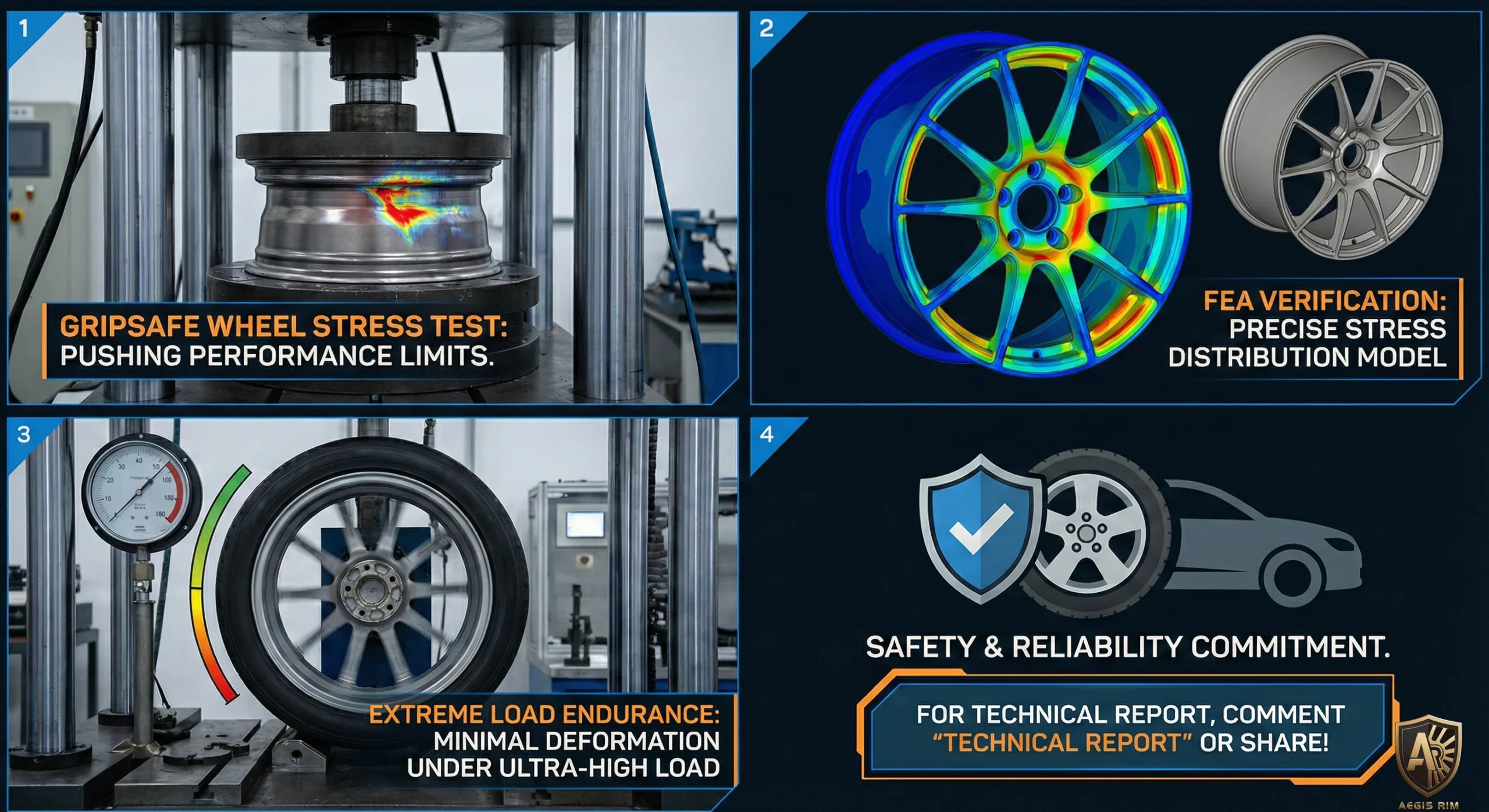
Every GripSafe wheel undergoes threshold-load testing across multiple vectors—axial, radial, and torsional—to replicate the most demanding real-world fatigue conditions. The result: engineering confidence measured in verifiable data.
Structural Endurance Beyond Industry Norms
Each AEGIS GripSafe wheel undergoes physical load cycles that exceed SAE and JWL standards by over 25%, ensuring the design supports extreme G-forces and load reversals. Data collected from strain gauge sensors is mapped back to digital FEA models for real-time correlation and validation.
FEA Analysis – From Concept to Reality
Finite Element Analysis (FEA) enables accurate modeling of wheel spoke deformation and hub stress transfer. Through iterative simulations, engineers identify micro-stress zones that inform geometry optimization—maximizing durability while maintaining minimal mass for improved rotational efficiency.

Real-World Impact: Proven Performance Data
With combined digital and physical testing, the GripSafe system achieves:
- +24% higher fatigue resistance under torsional load
- 99.2% correlation between FEA and real-world test results
- Certified safety validation following ISO 7141 fatigue cycle methodologies
- Enhanced reliability in both track and off-road conditions
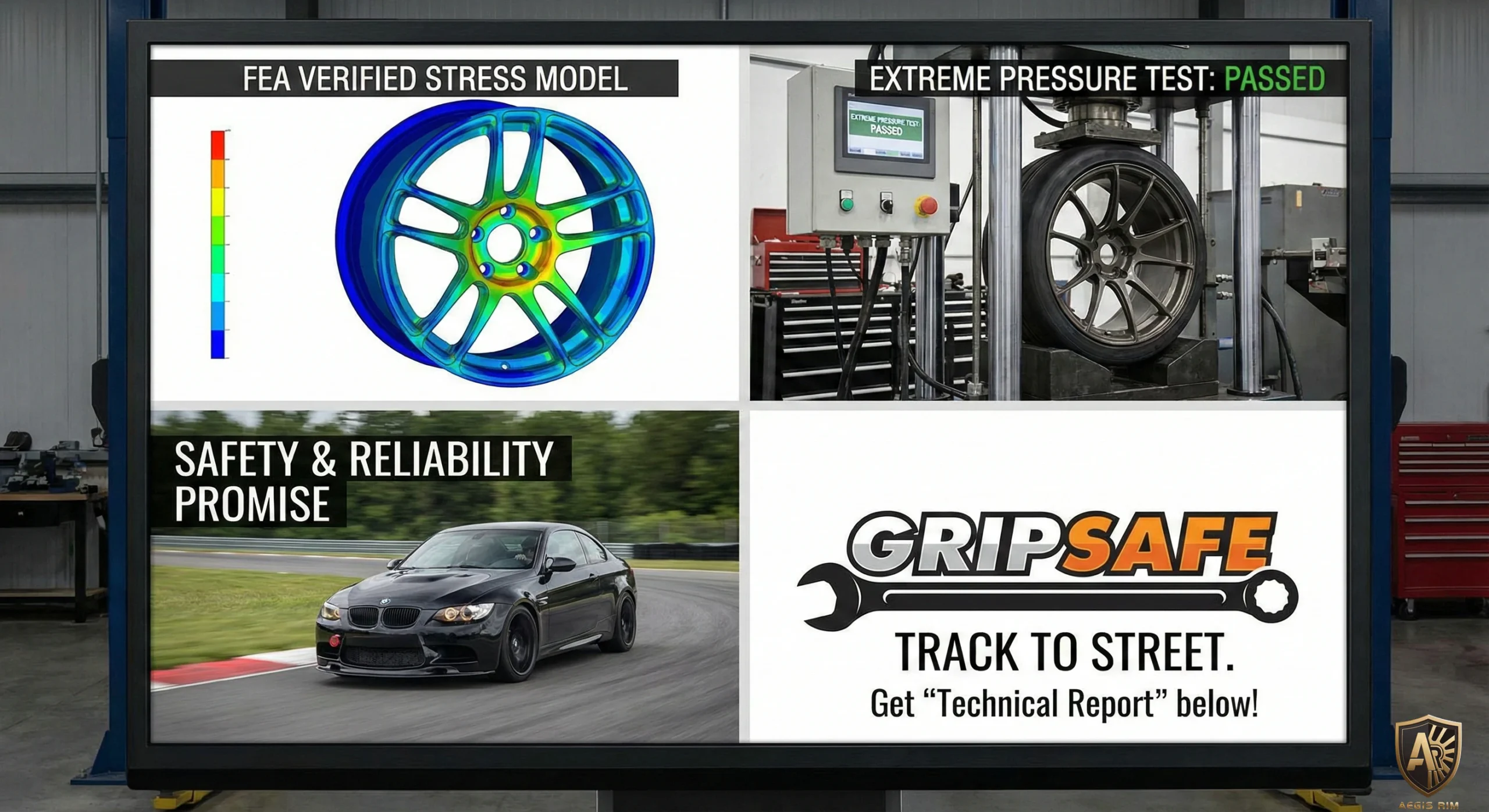
AEGIS RIM’s GripSafe Engineering Protocol blends simulated intelligence with material science and full-scale verification. Each wheel is not just modeled for strength — it’s empirically confirmed. Through FEA validation and mechanical endurance benchmarks, GripSafe proves that structural certainty is not an assumption, but an achievement.