CFD Brake Cooling & Aerodynamics: How AEGIS RIM Engineering Improves Heat Management
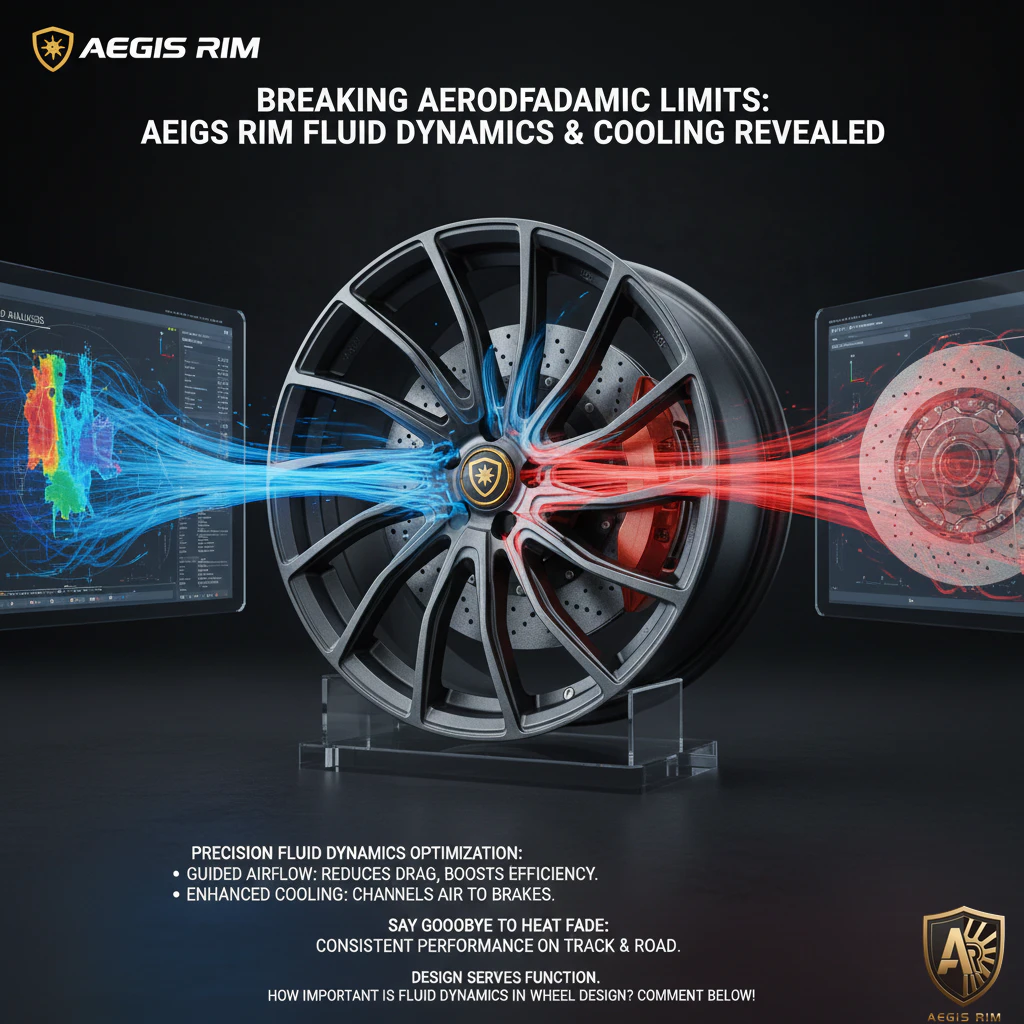
High-speed braking generates extreme thermal loads that directly challenge wheel performance and material integrity. Computational Fluid Dynamics (CFD) enables engineers to visualize airflow behavior and thermal dissipation with precision, revealing opportunities to optimize brake cooling without compromising structural strength.
In this analysis, we explore how AEGIS RIM’s design philosophy leverages CFD insights to enhance brake cooling, reduce thermal stress, and support consistent performance under demanding conditions.
Why Brake Cooling is Critical for Performance
When braking at high speeds or during repeated deceleration cycles, brake rotors and pads can exceed temperatures that compromise friction levels. Excess heat degrades brake compounds and can cause fade, reducing stopping power at precisely the moment it’s needed most. Proper wheel design must facilitate heat extraction through airflow pathways and surface geometry.
CFD Insights: Airflow & Thermal Distribution
Computational Fluid Dynamics lets us analyze how air travels around wheel spokes, through venting gaps, and across rotor surfaces. Visualizing this airflow reveals critical zones where heat accumulates, and opportunities where channeling air can extract heat more effectively. These simulations guide refinements that provide tangible performance benefits.
AEGIS RIM: Engineering Brake Cooling for Real Roads
AEGIS RIM’s approach integrates CFD-driven optimization into every design iteration. By fine-tuning spoke geometry and open areas, engineers create aerodynamic channels that direct cooling air toward brake components during forward motion. This results in:
- Improved heat extraction during high-speed braking
- Reduced brake fade in performance cycles
- Enhanced pad and rotor life due to balanced cooling airflow
- Better driver confidence from predictable stopping power
CFD is not just a simulation — it’s a powerful engineering tool that bridges the gap between theory and real-world performance. AEGIS RIM’s CFD-informed design philosophy enhances brake cooling efficiency, delivering better control, reduced fade, and enhanced durability under demanding conditions. For drivers who push the limits on track or road, brake cooling is a decisive advantage — and AEGIS RIM ensures you’re equipped for it.