5 Surprising Truths About Custom Wheels That Go Way Beyond Style
Most people see custom wheels as purely automotive jewelry—a way to give their vehicle a personal touch and make it stand out from the crowd. But beneath the polished chrome and aggressive designs lies a world of performance engineering, surprising safety features, and critical science. The wheels you choose don’t just impact your car’s look; they dictate everything from its handling and fuel economy to its very integrity when you hit a pothole.
This guide reveals the five most impactful truths about custom wheels that will fundamentally change how you view this common upgrade. It’s time to look beyond style and understand what’s really rolling underneath you.
01. Lighter Wheels Make You Smarter
The most significant performance benefit of lightweight wheels isn’t just about straight-line speed; it’s about making your entire suspension system work more effectively. This all comes down to a critical engineering concept: unsprung weight.
The Analogy
Reducing weight on your car is like a runner shedding pounds. But reducing unsprung weight is like switching from heavy work boots to lightweight running shoes. The weight in the shoes makes a far bigger difference in agility than weight carried in a backpack.
Unsprung weight is the mass your vehicle’s suspension does not support—namely, the wheels, tires, and brakes. Reducing it allows your shocks and springs to react more quickly and keep the tires planted on the pavement.
A driving test conducted by Tire Rack provides a real-world demonstration of this physics. When the suspension had less mass to manage, the car felt “light and nimble,” with dramatically improved steering feel and responsiveness.
02. Strength is an Active Safety System
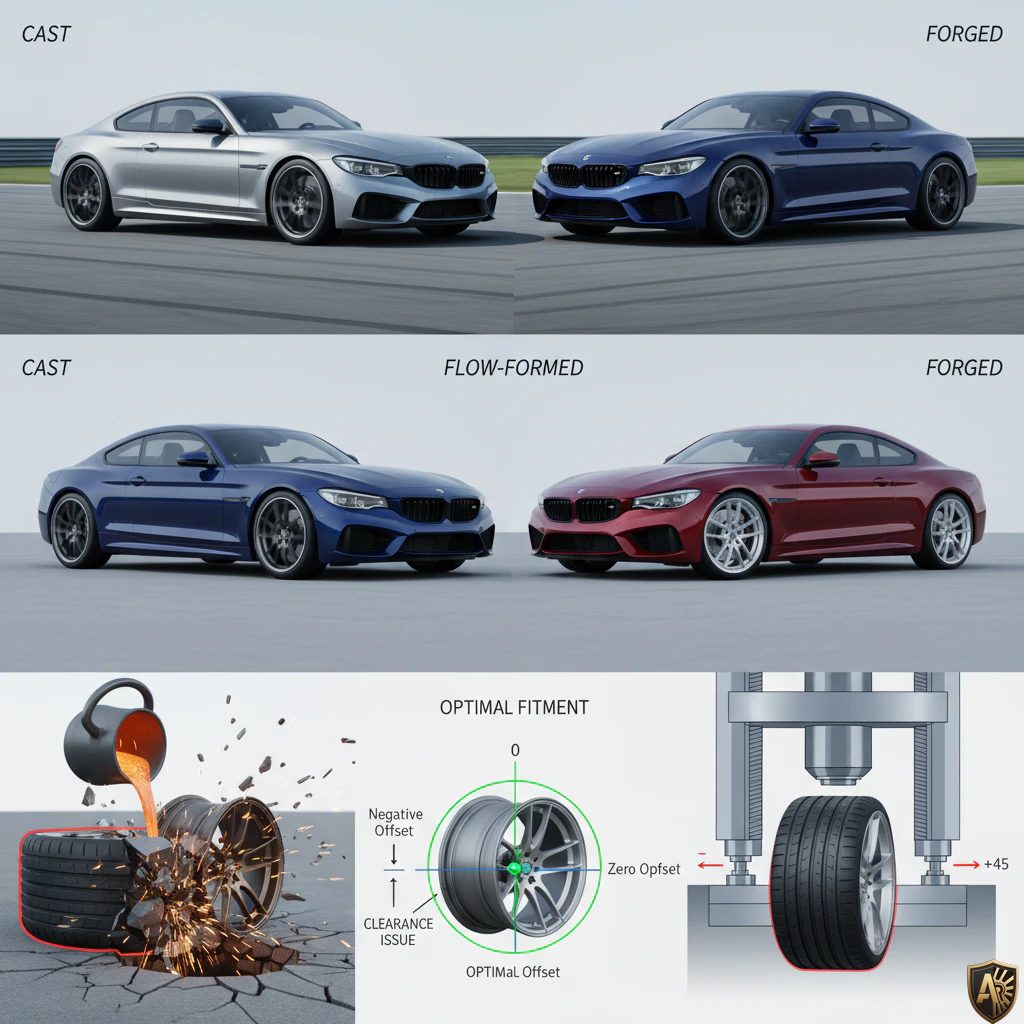
When you think of a “strong” wheel, you usually picture something that can survive a curb. But in wheel engineering, true strength is defined by how a wheel fails under extreme stress. The difference lies in how they are made.
Cast Wheels
Molten A356 aluminum poured into a mold. Cost-effective but prone to microscopic weak points and brittleness.
Forged Wheels
Solid 6061-T6 aluminum billet subjected to immense pressure. High density, aligned grain, and incredible durability.
Imagine hitting a deep pothole at speed. A brittle cast wheel is prone to a violent, sudden failure—it can crack or even shatter. A ductile forged wheel, however, is engineered to bend instead of break.
“A 6061-T6 forged wheel has a ductile nature, which means it is designed to bend instead of break. This provides a predictable, manageable failure.”
03. The Diminishing Returns of “Upsizing”
The trend of “upsizing” is undeniably popular for its bold visual statement. While a modest increase can improve handling by allowing for wider, lower-profile tires, there is a point where style begins to sabotage performance.
The physics are simple: once wheels become too large, any handling advantage is outweighed by increased inertia. It takes more energy to get a larger wheel spinning and more force to stop it. This directly harms acceleration and braking.
04. Forged, Cast, and “Flow-Formed”
Marketers often present flow-forming as a near-equivalent to true forging, but it is a hybrid process. It begins with a wheel that has a cast face. Only the barrel is heated and spun to strengthen it.
The Truth About Hybrid Wheels:
- • Barrel is stretched for durability and weight reduction.
- • The center and spokes remain cast (and potentially brittle).
- • A valid cost-performance compromise, but not a full forge.
05. Offset: The Science of Fitment
The final, crucial step that unlocks all benefits is getting the fitment right. Offset is the distance from the wheel’s mounting surface to its geometric centerline.
Positive Offset
Mounting surface toward the street side. Modern standard.
Zero Offset
Aligned perfectly with the geometric center.
Negative Offset
Mounting surface toward the suspension side (Deep Dish).
Choosing the wrong offset can lead to accelerated tire wear, increased steering effort, and fender rubbing. It is a carefully engineered specification, not an accident.
A Foundation for Performance
Custom wheels are far more than automotive jewelry. They represent a complex and critical intersection of engineering, safety, and style. The next time you admire a set of custom wheels, look past the shine. You’re looking at the foundation of a vehicle’s performance and safety.