120 km/h Tire Blowout: Uncovering the Shocking Truth
It’s a driver’s worst nightmare: cruising down the highway at 120 km/h, feeling secure, when suddenly—bang! A tire blows. In that terrifying second, your world can turn upside down. What exactly unfolds in those critical milliseconds, and is there any way to mitigate such a disaster?
The catastrophic consequences of a sudden loss of tire pressure at high speeds aren’t just bad luck; they’re a chilling demonstration of pure physics and material engineering failure. At AegisRim, we’ve engineered a solution that transforms this nightmare scenario into a manageable event through our revolutionary AEGIS GripSafe technology.
The Nightmare Unfolds: What Happens in a Blowout at 120 km/h?
When a vehicle travels at a significant speed, like 120 km/h (approximately 75 mph), and a tire experiences an instant loss of pressure (a blowout), a rapid and devastating sequence of events occurs. The internal tire pressure drops to zero almost instantaneously, triggering a cascade of failures. Understanding this sequence is critical to appreciating why advanced safety systems like AEGIS GripSafe are essential for modern highway driving.
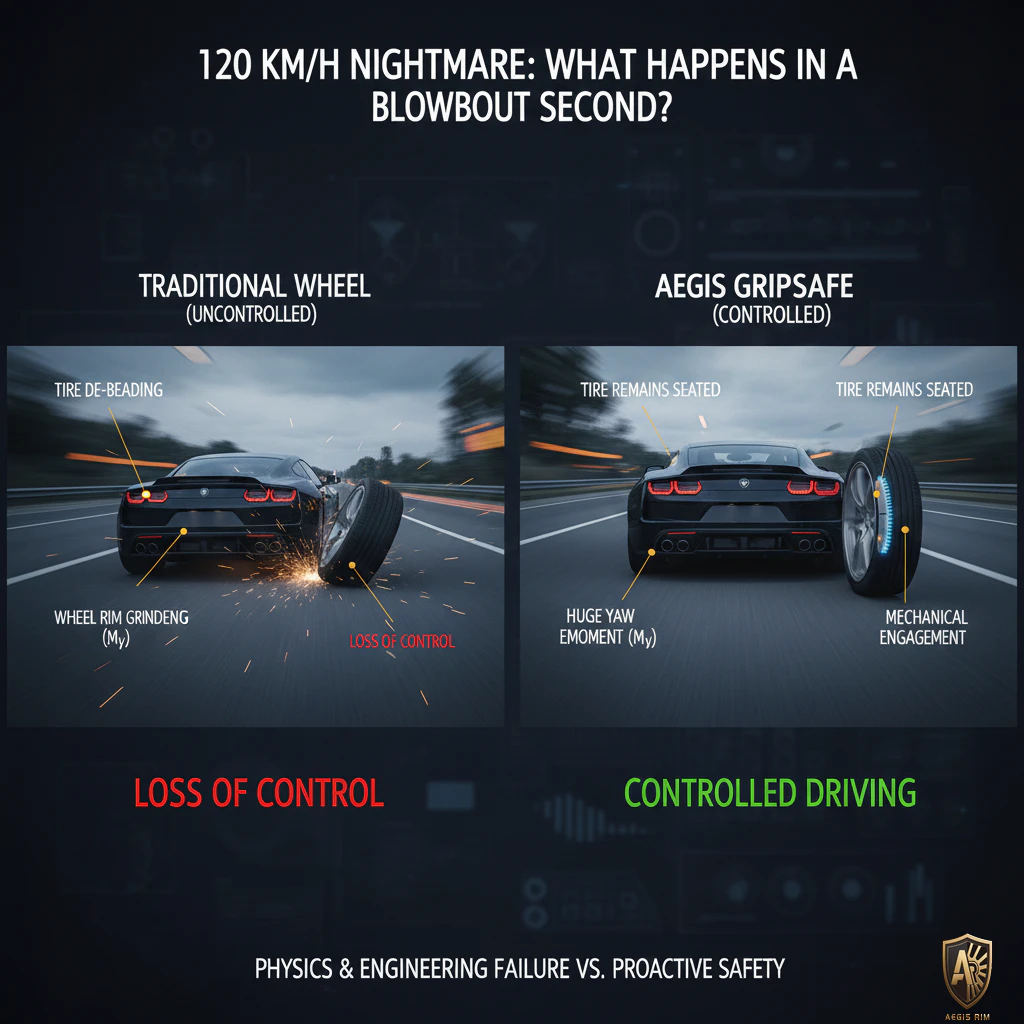
The Chain Reaction of Disaster
These events happen incredibly fast, within milliseconds, leaving drivers with little to no time to react safely. Let’s break down the physics of what occurs:
1. Load Transfer and Imbalance
With the sudden loss of air pressure, the tire can no longer support its share of the vehicle’s weight. The entire vertical load (Fv) on that wheel instantly shifts directly onto the wheel hub and the road surface. The tire’s sidewall, no longer rigid, is crushed under immense shear forces, causing the wheel rim to directly scrape and cut into the tire wall.
At highway speeds, a typical passenger vehicle corner weight ranges from 350-500 kg. When the pneumatic support vanishes, this entire mass bears down on collapsing rubber and metal—a structural load the deflated tire was never designed to handle.
2. Tire De-beading (Bead Unseating)
The tire bead – the edge of the tire that seals against the wheel rim – relies on internal air pressure and friction to stay seated. When that pressure vanishes, the inertial forces (I) and lateral forces (Flat) acting on the tire overwhelm the reduced friction between the bead and the rim.
The tire bead separates from its seat on the rim, and the tire completely detaches from the wheel. This is often accompanied by the tire shredding itself apart—rubber fragments can become projectiles, creating additional hazards for other vehicles. The high-speed rotation combined with sudden structural failure creates a violent, explosive event.
3. Massive Torque Disturbance and Loss of Control
Once the tire detaches, the vehicle’s suspension system loses its intended elastic cushioning. The contact point with the road abruptly changes from flexible rubber to the rigid, often uneven, edge of the metal wheel rim. This creates an extremely large, asymmetrical yaw moment (My) around the vehicle’s rotational axis.
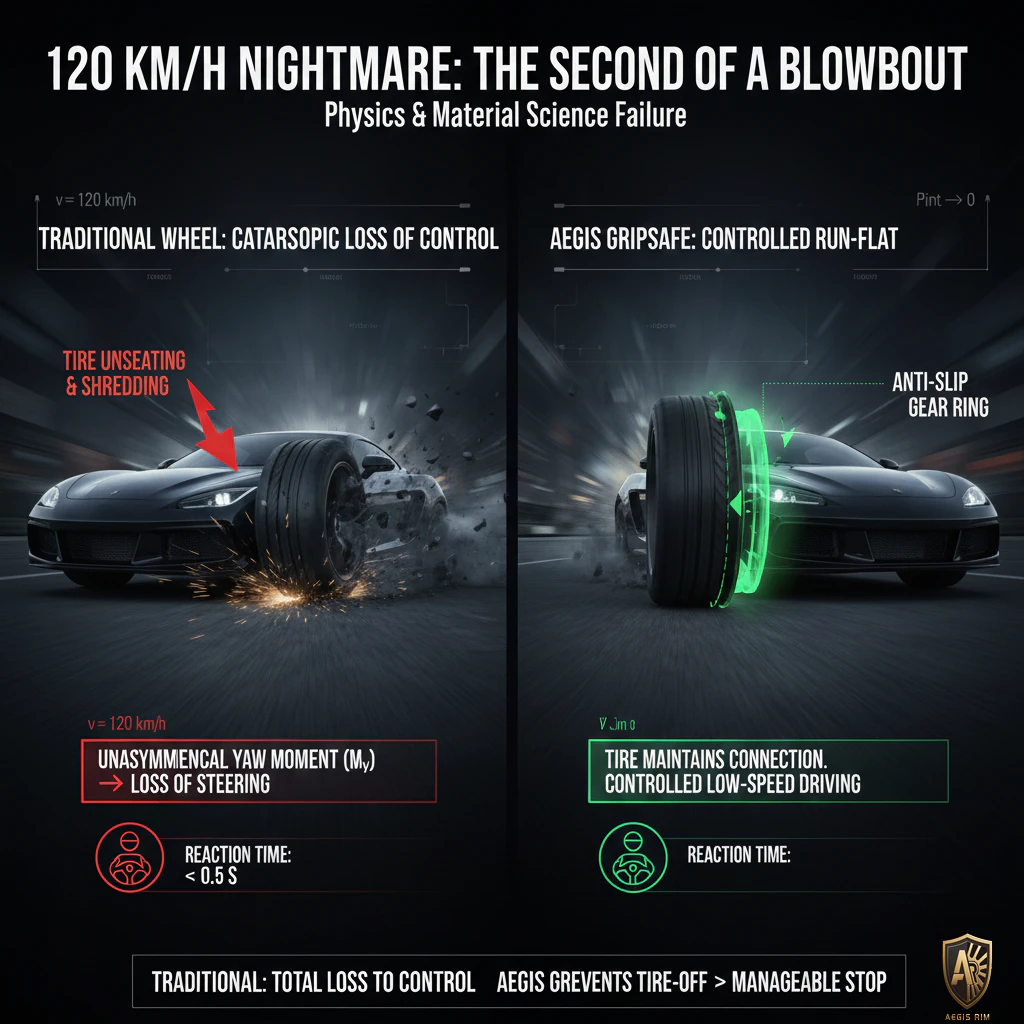
The car is suddenly pulled violently in one direction. The driver faces an immediate, critical challenge: combating this sudden, powerful force within a minuscule reaction time, typically less than 0.5 seconds. For most drivers, this is an impossible task, leading to a catastrophic loss of control. Even experienced drivers struggle to maintain vehicle stability when one corner suddenly loses 100% of its grip while simultaneously introducing massive directional forces.
Traditional Wheel Response to High-Speed Blowout:
A Glimmer of Hope: How AEGIS GripSafe Changes the Game
While the traditional blowout scenario is terrifying, innovative technologies are emerging to tackle this critical safety issue head-on. Advanced wheel technologies, like AEGIS GripSafe, are specifically designed to prevent the catastrophic second step described above: tire de-beading.
The Engineering Behind GripSafe
AEGIS GripSafe works by employing an anti-slip gear ring structure within the wheel. The moment tire pressure drops to zero, this mechanical engagement, through its anti-slip gear teeth, forcibly locks the tire bead onto the rim. This crucial feature prevents the tire from separating from the wheel.
Instead of an uncontrollable disaster, AEGIS GripSafe transforms the situation into a manageable event. Drivers can maintain a degree of control, allowing them to safely reduce speed and pull over. This isn’t about avoiding the blowout itself, but about controlling its aftermath—and that makes all the difference between a minor inconvenience and a major accident.
Critical Safety Advantages
- Prevents tire separation: The anti-slip gear ring mechanically locks the tire to the rim, eliminating the most dangerous phase of a blowout
- Maintains directional stability: By keeping the tire seated, the vehicle experiences significantly reduced yaw moment, preserving steering control
- Extends reaction time: Drivers gain precious seconds to assess the situation and respond appropriately, rather than fighting immediate loss of control
- Run-flat capability: Vehicles can continue operating at reduced speed to reach a safe stopping location, eliminating the need to stop in dangerous highway locations
- Protects surrounding traffic: Prevents tire debris from becoming projectiles that endanger other vehicles
Traditional Wheel vs. AEGIS GripSafe Performance:
In essence, AEGIS GripSafe shifts the paradigm from “Physics & Engineering Failure” to “Proactive Safety.” It’s a testament to how intelligent design can turn a potentially fatal incident into a relatively safe, albeit inconvenient, one.
Engineering Safety into Every Mile
The reality of a high-speed tire blowout is grim, but advancements like AEGIS GripSafe offer a tangible solution to mitigate the immediate dangers. By preventing the catastrophic de-beading that transforms a tire failure into a life-threatening loss of control, this technology represents a fundamental advancement in automotive safety.
Prioritizing safety through such innovations is paramount for all drivers on North American highways. At AegisRim, we believe that advanced engineering should always serve human safety first. Because when disaster strikes at 120 km/h, the difference between catastrophe and control comes down to the engineering decisions we make today.