Centrifugal Force and Tire Dynamics: The Invisible Threat at High Speed
How standing waves form inside your tires—and how advanced wheel engineering helps prevent catastrophic failure on North American highways.
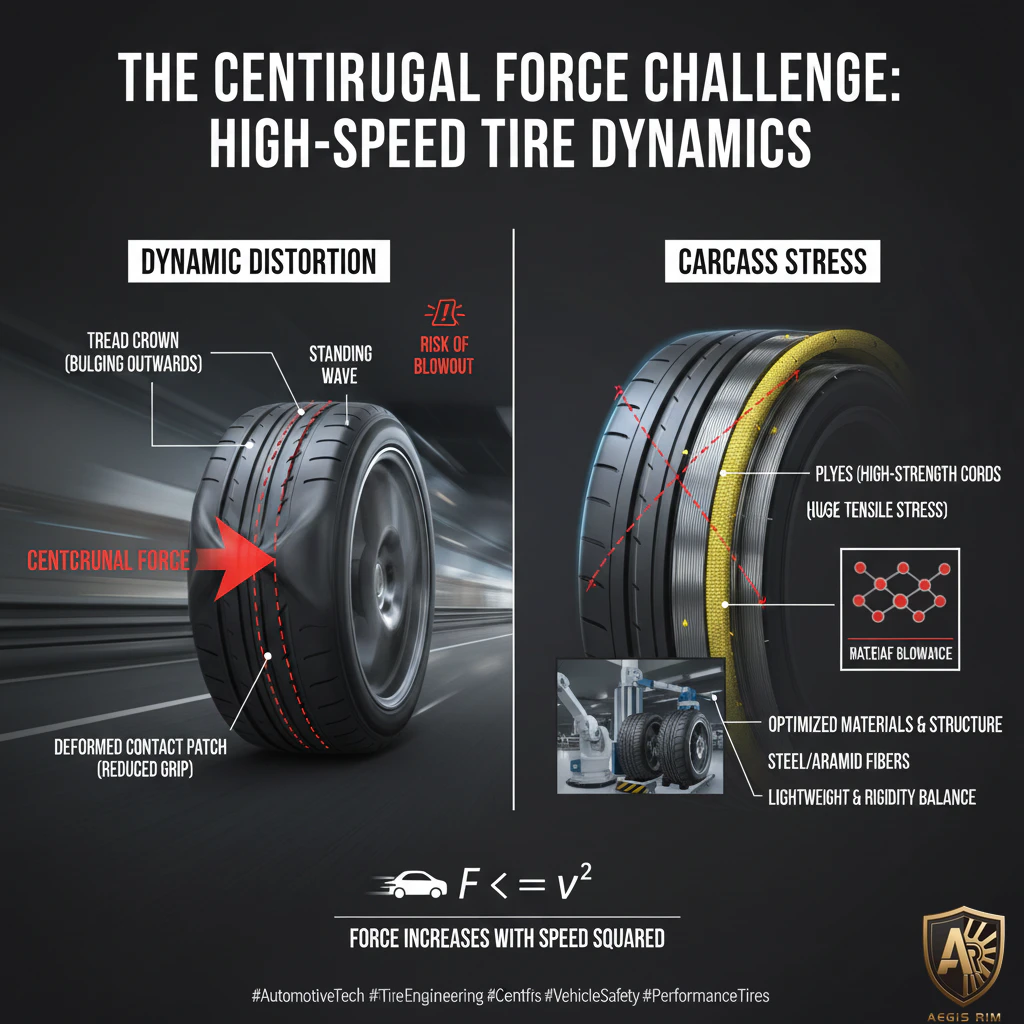
At highway speeds, your tires experience forces far beyond what the human eye can perceive. One of the most dangerous—and least understood—is centrifugal force. As rotational speed increases, internal tire structures begin to stretch, distort, and oscillate.
When this motion becomes uncontrolled, a phenomenon known as the tire standing wave emerges—an internal deformation pattern capable of destroying a tire within seconds. At AegisRim, we design forged wheels and bead-retention systems to work with tire dynamics, not against them.

What Happens Inside a Tire at High Speed
As rotational velocity rises, centrifugal force attempts to pull every internal fiber of the tire outward. The steel belts, textile cords, and rubber matrix begin to flex thousands of times per minute.
When heat buildup and structural fatigue reach critical levels, the tire can no longer stabilize its shape. This is where deformation becomes dynamic—and dangerous.

Standing Waves: When Tires Begin to Self-Destruct
A standing wave forms when sections of the tire wall stop returning to their original shape between rotations. Instead, the rubber folds into repeating wave patterns.
- Rapid internal heat accumulation
- Sudden loss of structural tension
- Violent vibration transmitted into suspension components
- High probability of explosive tire failure
This phenomenon historically limited top speeds in early racing and aircraft tires. Today, it remains a real threat for overloaded vehicles, under-inflated tires, and improperly matched wheel systems.
How AegisRim Engineering Reduces Standing Wave Risk
Tire stability does not depend on rubber alone. The wheel plays a decisive role in maintaining bead geometry, pressure integrity, and rotational balance.
AegisRim forged wheels feature ultra-precise bead seat tolerances and our proprietary GripSafe Technology, preventing micro-slippage and pressure instability during extreme rotational stress.
Centrifugal force is invisible—but its consequences are not. Standing waves remain one of the most destructive tire failure mechanisms at speed. Through precision forging, structural optimization, and advanced bead-locking geometry, AegisRim wheels provide a vital layer of stability for modern performance vehicles. For drivers across the United States who demand safety at speed, engineering matters.