01
Active Bead-Lock
Zero-PSI Tire Retention
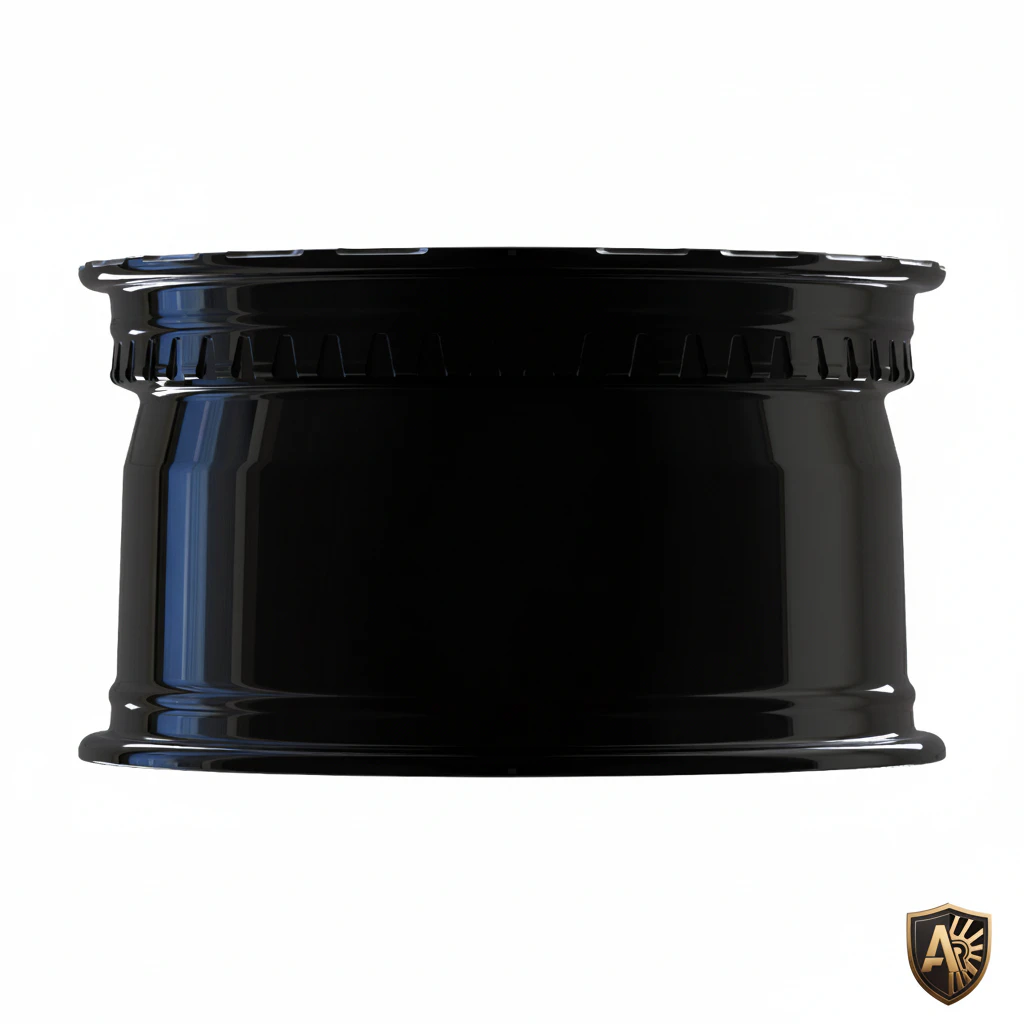
The patented mechanical bead-lock system clamps the tire bead with 3,200 lbs of holding force per side. Even at absolute zero pressure, the tire remains fully seated on the rim — preventing the catastrophic wheel separation that causes most blowout rollovers.
02
Thermal Dispersion
Heat That Cannot Build
Aerospace-grade 6061-T6 aluminum with integrated radial dispersion channels moves brake-generated heat away from the tire contact zone three times faster than conventional cast wheels. Sustained track-day braking and mountain descents no longer threaten tire integrity.
03
Mono-Forged Integrity
One Billet. No Weak Points.
Every AEGIS RIM wheel is machined from a single forged billet under 9,000 tonnes of hydraulic pressure. The continuous grain structure has no welds, joints, or cast porosity — eliminating the structural discontinuities where competitive wheels fail under impact.
04
Zero-Slip Retention
Mechanical Lock at Any Pressure
Three independent retention rings, each machined to ±0.01 mm tolerances, create a mechanical interlock between tire and wheel. No adhesive, no foam, no chemical bond — pure geometry holds the assembly together through cornering loads that exceed 2.5G.
05
Run-Flat Capability
20+ Miles After Full Blowout
When pressure loss occurs, GripSafe® transitions seamlessly to run-flat mode. The wheel's internal support geometry carries vehicle load at up to 50 mph for a minimum of 20 miles — enough to reach safety on any North American highway without pulling over in a live lane.
06
Full Steering Response
Control Through Pressure Loss
Conventional blowouts cause immediate and violent steering pull. GripSafe® distributes the load symmetrically during deflation, allowing drivers to maintain lane position and execute a controlled stop. Steering input remains predictable from the moment of failure to standstill.
07
Impact Absorption
Road Shock That Stops at the Rim
Radial forging aligns aluminum grain flow with the primary impact vectors. The resulting micro-crystalline structure deforms elastically under pothole and curb strikes that would crack a cast wheel — absorbing energy rather than transmitting it to suspension components and the cabin.
08
Corrosion Resistance
Chemically Armored Surface
A four-stage surface treatment — alkaline clean, acid etch, hard anodize to 25 µm, and clear-coat seal — creates a barrier impervious to road salt, calcium chloride, brake dust, and wheel-cleaning chemicals. Salt spray certification exceeds 1,000 hours with zero visible corrosion.
09
Balanced Mass Distribution
Vibration-Free at Any Speed
Computer-controlled CNC machining achieves static balance within 2 grams without correction weights. The rotational mass asymmetry that causes highway shimmer and uneven tire wear is engineered out at the source — not corrected with adhesive counterweights that can migrate.
10
Precision Fitment Tolerances
±0.01 mm. Every Wheel.
Hub-centric bore, bolt-circle diameter, and seat angle are held to ±0.01 mm on every wheel produced. Perfect hub contact eliminates micro-movement under acceleration and braking — preventing the fretting corrosion and lug nut loosening that develops on wheels with loose OEM tolerances.
11
Structural Load Rating
40% Above OEM Specification
Every wheel design is independently tested by TÜV SÜD to JWL and VIA standards. AEGIS RIM wheels are certified to dynamic radial load ratings at least 40% above the vehicle's OEM specification, verified through 500,000 fatigue cycles without crack initiation.
12
NEX Senser Integration
Accurate TPMS Through Full Deflation
The wheel architecture is co-engineered with the NEX Senser TPMS module. The sensor mounting cavity isolates the module from rim deflection stresses, and the internal geometry allows accurate pressure readings — including during active deflation — so drivers receive real data, not lag.
13
Fatigue Resistance
Engineered for a Lifetime
Resonance frequency analysis during design identifies and eliminates harmonic fatigue modes. Physical validation follows: 500,000 rotational cycles under maximum rated load, biaxial fatigue simulation of combined cornering and braking forces, and impact testing at 30J per JWL+R protocol.